
Ingredients
Method
- Preheat the oven to 425°F. Keep the carrots near 68°F so they stay firm while you work. Peel 12 medium Nantes carrots and trim both ends during an 8 to 10 minute prep. Slice each carrot lengthwise with one steady downward motion to make 24 long halves. Keep every piece between 1/2 and 3/4 inch thick at its widest point. Next, blot the 24 halves for 2 minutes until their surfaces look matte instead of wet. The cut faces should sit flat and the pointed ends should remain intact. Uneven thickness makes thin pieces wrinkle before thick pieces soften, so correct any oversized half. Even cuts roast together because heat reaches each center at the same pace.

- Heat the oven to 425°F and let the melted butter cool to about 110°F. Stir the butter with extra-virgin olive oil, finely grated garlic, kosher salt, black pepper and dried thyme for 30 seconds. Add the 24 carrot halves and turn them from the bottom upward for 2 minutes. Then fold in 1/4 cup Parmigiano-Reggiano until the flat faces carry a thin speckled coat. The carrots should look glossy but not flooded, and tiny cheese strands should cling instead of sinking. You'll smell raw garlic clearly while the butter stays fluid. Scrape any garlic from the bowl back onto the carrots before transferring them. Hotter butter clumps the cheese, but cold butter leaves greasy patches. Warm fat coats evenly because it stays fluid without melting the cheese.
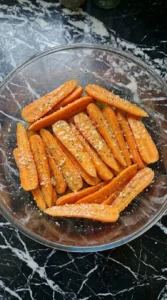
- Transfer the coated halves to an 18×13-inch sheet pan and arrange them cut-side down with about 1/2 inch between pieces. Roast at 425°F for 15 minutes and rotate the pan at minute 8. At minute 15, flip each half so the rounded side touches the pan and shift the darker pieces toward the center. The first side should show amber patches and the centers should bend slightly without collapsing. You'll hear a steady sizzle and smell the garlic turning sweet. If the pieces overlap, they steam and Garlic Parmesan Roasted Carrots turn soft instead of caramelized. High heat drives off surface moisture before the carrot centers turn tender.

- Scatter the remaining 1/4 cup Parmigiano-Reggiano across the flipped carrots and roast at 425°F for 7 to 9 minutes. Don't move the pieces during this final stretch. The cheese needs direct heat to form uneven golden patches while the carrot tips deepen from orange to orange-brown. (I tried 450°F first, the garlic darkened before the centers softened. 425°F is the fix.) Finally, check the thickest half at minute 7. A small knife should slide in with light resistance, and the pan should smell like toasted cheese and sweet garlic. Go past 9 minutes and the smallest tips can turn bitter. The final heat browns the cheese while the carrot interiors finish softening.

- Rest the pan at room temperature near 70°F for exactly 3 minutes. Then transfer six carrot halves to each 10-inch plate, placing the wider ends toward the center and the tapered ends outward. Spoon any browned garlic and cheese bits from the pan over the servings. Finish each portion with 1/2 tablespoon chopped flat-leaf parsley. The plated carrots should look glossy and irregular, with deep orange centers, caramelized tips and pale golden cheese clinging in patches. You'll smell butter and garlic before the parsley's fresh note appears. Plate too early and the hot fat runs away from the carrots. A short rest lets the butter settle and keeps the coating on each piece.

Notes
Store cooled Garlic Parmesan Roasted Carrots in a shallow airtight glass container for up to 4 days. Separate stacked layers with parchment so the cheese coating doesn't pull away. You can freeze them for 2 months, although the centers become softer after thawing. Freeze the pieces in one layer until firm, then move them into a sealed freezer bag with the air pressed out. Reheat refrigerated carrots on a sheet pan at 400°F for 8 to 10 minutes. Scatter 1 tablespoon fresh Parmigiano-Reggiano over them during the final 2 minutes and add parsley after heating. Discard leftovers that smell sour, feel slimy or show grey liquid in the container. Don't microwave longer than 90 seconds, since trapped steam quickly turns the browned edges soft.