Panettone Bread Pudding
A box of Italian panettone sitting in my kitchen after Christmas gave me the idea to make Panettone Bread Pudding. I haven’t shared many recipes using this sweet Italian bread on the blog yet, but this one was worth making. It’s rich and soft inside with a golden top that smells like vanilla and butter. This easy panettone bread pudding takes inspiration from traditional bread pudding and Italian Christmas baking.
It’s a super tasty dessert that uses a few basic ingredients and turns leftover holiday bread into something everyone can enjoy. And if you like sweet breakfast bakes, you should also try my Overnight Breakfast Casserole for another family breakfast idea. When people think about panettone they usually picture a tall Christmas loaf filled with raisins and candied orange peel. But you don’t have to serve it plain.
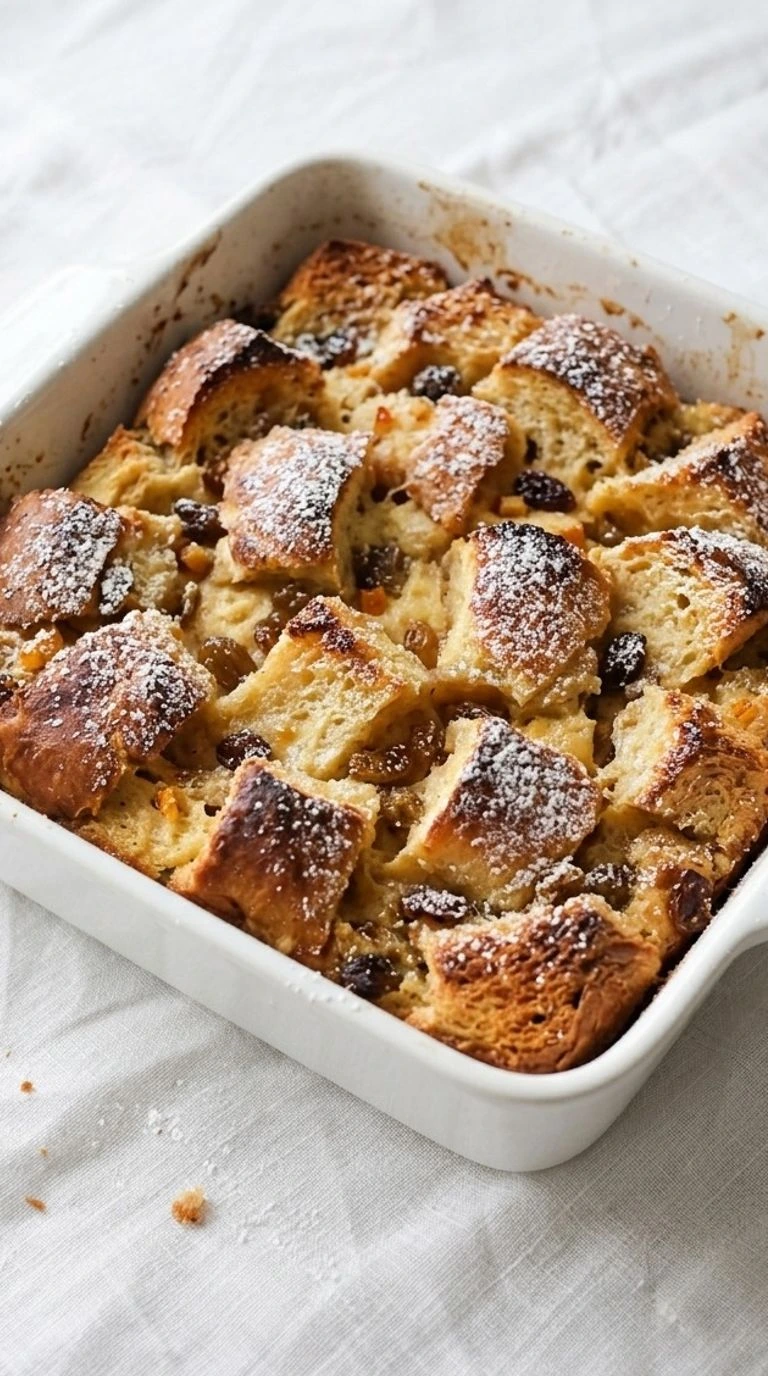
Once the bread soaks up a rich egg custard and bakes in the oven, it becomes soft in the middle while the top gets lightly crisp. I like making this dessert when family comes over during the holidays because it feels special without being hard to put together. You can serve it warm for Christmas brunch or bring it to the table after dinner. A little powdered sugar on top makes it even better.
Why This Recipe Works
Panettone Bread Pudding works well because Italian panettone already contains butter and eggs, so it turns tender when soaked in milk and cream. Toasting the cubes for 8 to 10 minutes removes some surface moisture and helps them soak up custard without breaking apart.
Baking at 350°F then gives the egg mixture time to set before the raised bread edges turn too dark. The 20-minute soak is worth keeping.
It gives the larger chunks time to soften while their tops stay crisp. If you enjoy desserts with warm spices and tender centers, try my Brown Butter Pumpkin Bread for another seasonal bake.
Ingredients
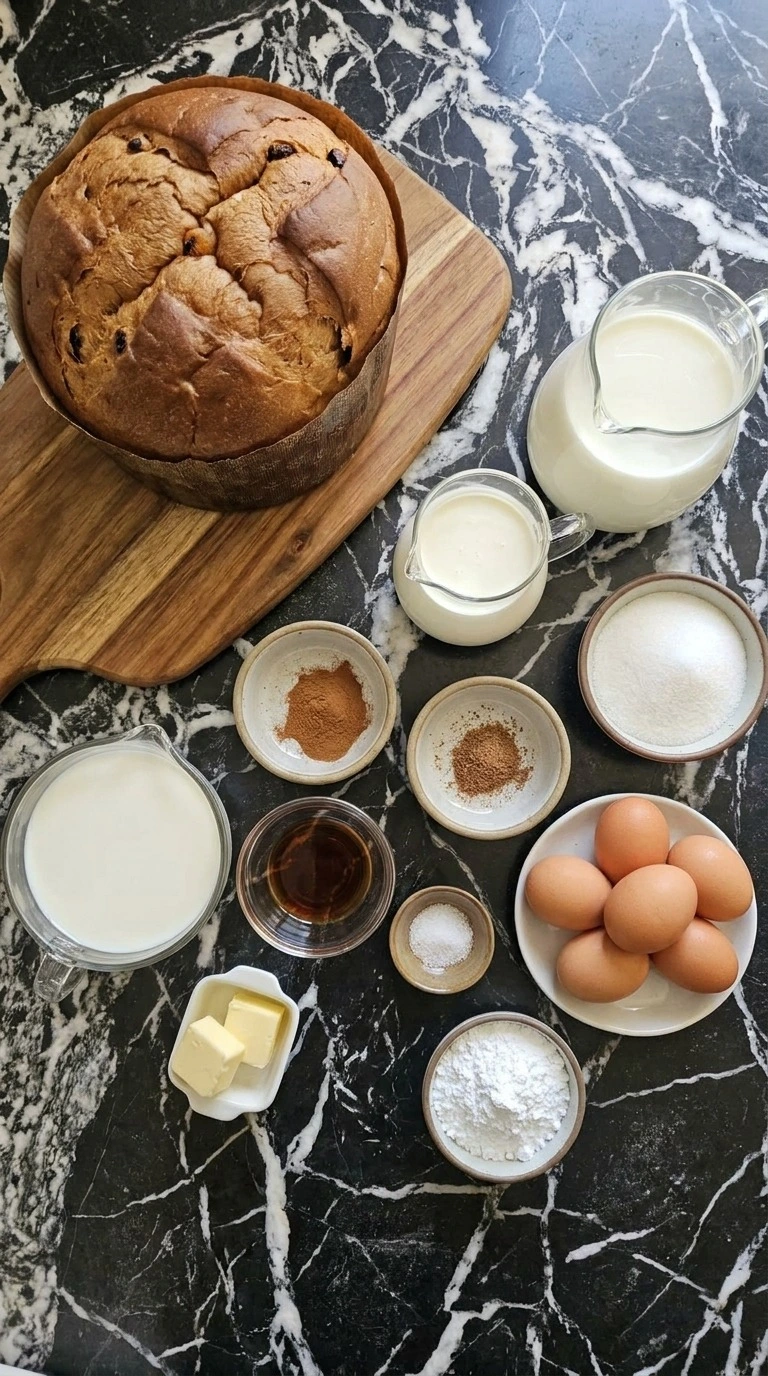
- Traditional Italian fruit panettone: Choose a classic loaf with golden raisins and candied orange peel. Cut into irregular 1.5-inch cubes and lightly toast to help the bread absorb custard.
- Large eggs: Use fresh eggs to help the custard set into a soft and tender filling during baking.
- Whole milk: Use whole milk for a smooth custard that soaks evenly into the airy panettone crumb.
- Heavy whipping cream: Adds richness and helps the baked pudding develop a soft and creamy texture.
- Granulated white sugar: Dissolve into the egg mixture to sweeten the custard without overpowering the already sweet panettone.
- Pure vanilla extract: Adds a warm vanilla flavor that complements the orange peel and raisins in the Italian bread.
- Ground cinnamon: Whisk into the custard for gentle warmth and a traditional Christmas baking aroma.
- Ground nutmeg: Adds a subtle sweet spice note without overpowering the vanilla custard.
- Fine sea salt: Balances the sugar and brings out the buttery flavor of the panettone.
- Unsalted butter: Soften before rubbing over the baking dish to prevent sticking and help the edges release cleanly.
- Powdered sugar: Sift lightly over the warm finished portions for a simple snowy Christmas finish.
Kitchen Equipment
- 9-inch square baking dish: A 9-inch square baking dish with sides at least 2 inches deep holds the bread and custard securely, while a shallower pan may overflow during baking.
- Large rimmed baking sheet: A rimmed baking sheet at least 13 by 18 inches spreads the panettone cubes into a loose layer for even toasting, while a crowded smaller tray can leave moist patches.
- 3-quart mixing bowl: A mixing bowl with at least 3 quarts of capacity gives you room to blend the custard without spills, while a smaller bowl makes it harder to whisk smoothly.
- Balloon whisk: A sturdy balloon whisk around 10 to 12 inches long breaks up the eggs and blends the milk and cream, while a small fork may leave streaks of unmixed egg.
- Serrated bread knife: A serrated knife with an 8-inch blade cuts the soft panettone into cubes without crushing it, while a dull straight blade tends to compress the airy crumb.
- Silicone spatula: A flexible silicone spatula at least 10 inches long helps move custard and gently press the bread, while a rigid tool can tear the soaked cubes.
- Instant-read food thermometer: An instant-read thermometer with a thin probe lets you check for 165°F in the custard center, while a thick probe can leave a large hole in the soft pudding.
- Fine-mesh sugar sifter: A small fine-mesh sifter around 3 inches wide spreads powdered sugar evenly over each portion, while large holes can drop thick clumps onto the crust.
How to Make It
Step 1: Cut and lightly toast the panettone
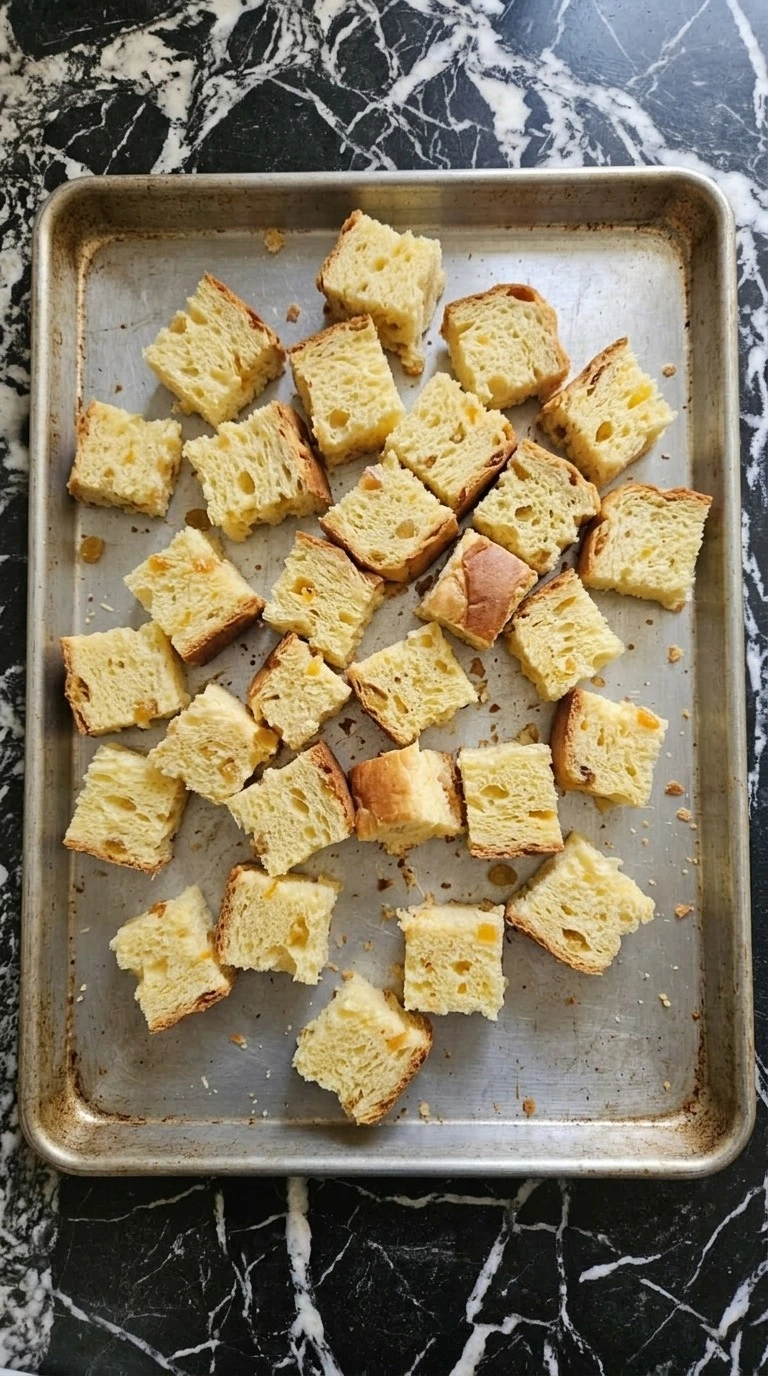
Start by setting your oven to 300°F. Cut the 18-ounce Italian fruit panettone into rough 1. 5-inch cubes with a serrated knife. Keep the pieces a little uneven because the smaller bits will turn crisp while the larger ones stay soft.
Spread the cubes in one loose layer on a large rimmed baking sheet. Toast for 8 to 10 minutes and turn them once halfway through. Then remove the sheet and let the bread cool for 5 minutes. Don’t let it turn dark brown.
The pieces should feel slightly dry on the outside but still soft when pressed in the middle. You’ll smell the orange peel as they warm. Toasting too long will make the edges hard instead of tender. A brief dry toast helps the bread absorb custard without falling apart.
Tip: If your panettone has been sitting open for 2 days and already feels dry, skip the oven toast and use it as it is.
Step 2: Whisk the vanilla custard until smooth
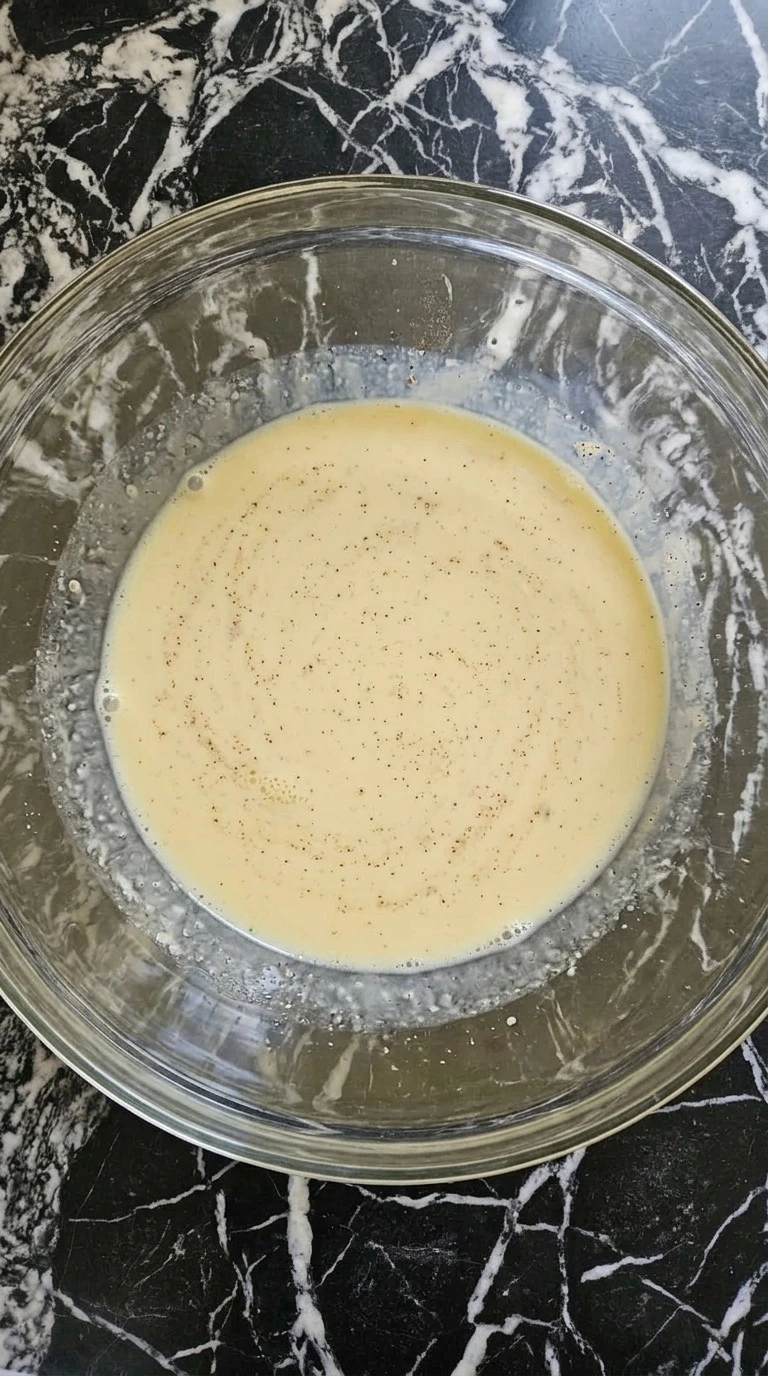
While the bread cools, crack 6 large eggs into a large mixing bowl and whisk for 45 seconds until the yolks and whites blend. Add 1/2 cup granulated white sugar and keep whisking for another minute. Next pour in 2 cups whole milk and 1 cup heavy whipping cream. Add 2 teaspoons pure vanilla extract and 1 teaspoon ground cinnamon with 1/4 teaspoon ground nutmeg and 1/4 teaspoon fine sea salt.
Whisk for 60 seconds until the sugar starts to dissolve. Keep everything near 68°F and don’t heat the mix. The custard should look pale yellow with tiny cinnamon flecks spread through the liquid. No thick streaks of egg should remain.
If you stop whisking too soon, some bites may have a firm eggy texture. A smooth cold custard helps the pudding bake with an even creamy center.
Tip: Use a deep bowl with at least a 3-quart capacity because the custard mixture needs enough space for whisking without splashing.
Step 3: Soak the panettone in the baking dish
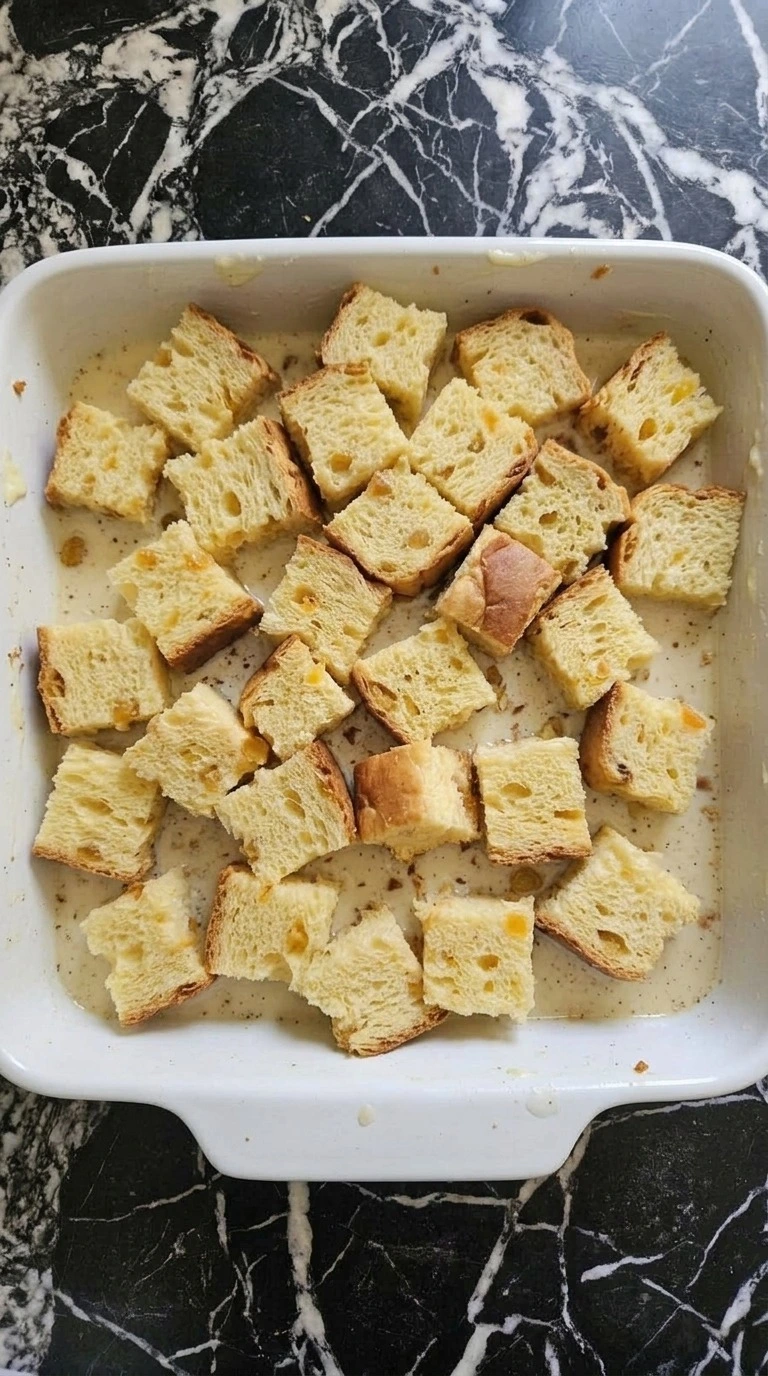
Raise the oven temperature to 350°F. Rub 1 tablespoon softened unsalted butter over the bottom and sides of a 9-inch square baking dish. Transfer the toasted panettone cubes into the dish and spread them in loose uneven layers. Pour the vanilla custard slowly over the bread and make sure you reach the corners.
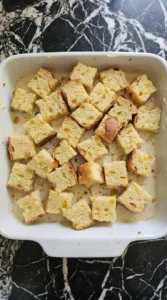
Then press the raised cubes gently with the back of a large spoon. Let the mixture soak for 20 minutes and press the top again after 10 minutes so the dry pieces absorb more liquid. The bread should look plump and moist with a little custard still visible between the cubes. Some golden edges will stick out above the liquid.
Don’t leave the mixture soaking for hours on the counter because the bread can break down. A 20-minute soak gives the centers time to soften while the tops keep their shape.
Tip: For a neat serving shape, leave about 1/2 inch of room below the baking dish rim so the custard can’t spill as it heats.
Step 4: Bake until the top turns golden and the center sets
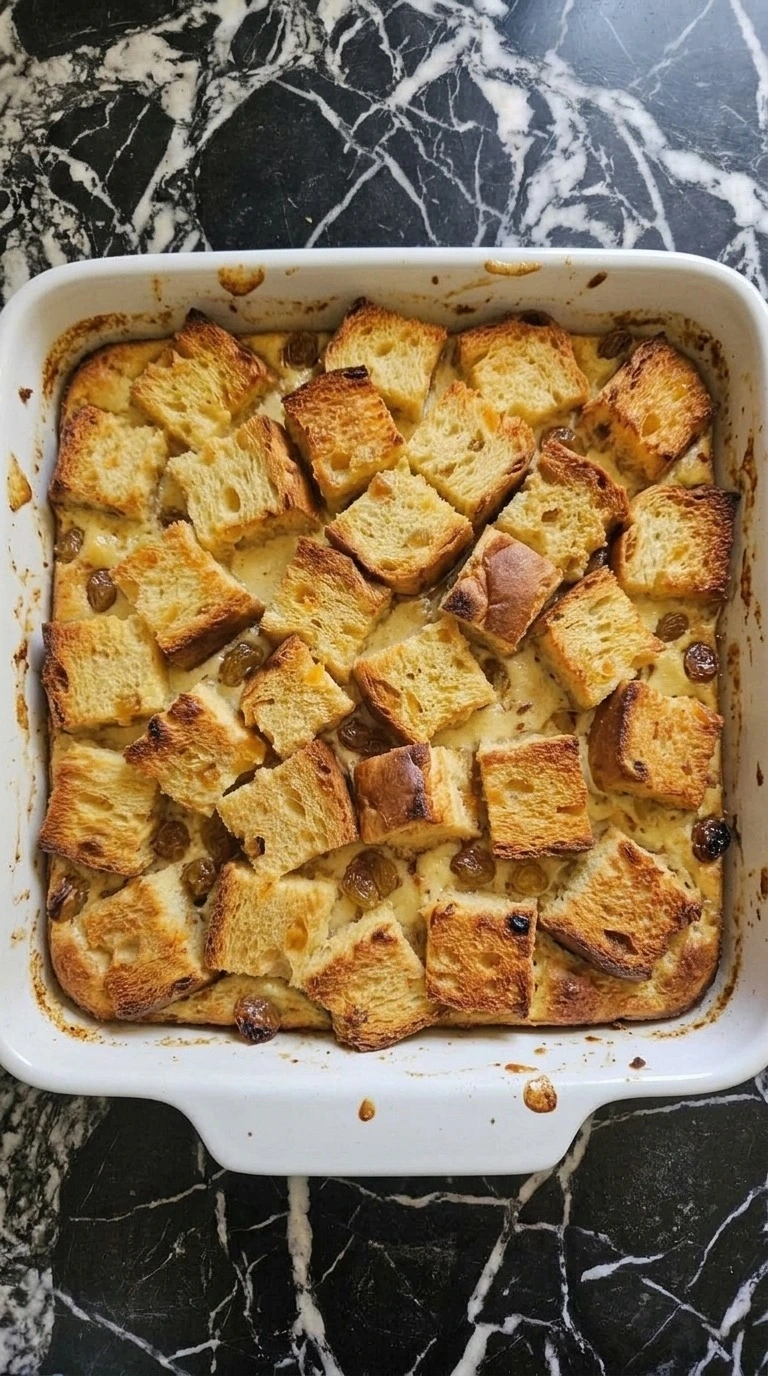
Place the filled baking dish on the middle oven rack at 350°F. Bake for 35 to 45 minutes until the top starts to turn a deep golden color and the custard sets around the bread. At minute 35 check the middle with a thin knife and look for moist crumbs rather than liquid custard. You can also check the center with a food thermometer and aim for 165°F.
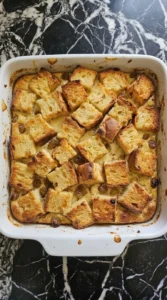
If the top gets too dark before the middle sets, cover it loosely with foil for the last 10 minutes. Don’t raise the oven heat to rush it. You’ll notice crisp amber corners and a gentle wobble in the center when you move the dish. The kitchen will smell like warm vanilla and orange peel.
(I found that a hotter oven made the top too dark before the center set. ) Moderate heat lets the custard firm up without drying out.
Tip: If you use an 8-inch square dish instead, expect a deeper pudding and check for doneness after 45 minutes rather than 35.
Step 5: Rest and serve with a dusting of powdered sugar
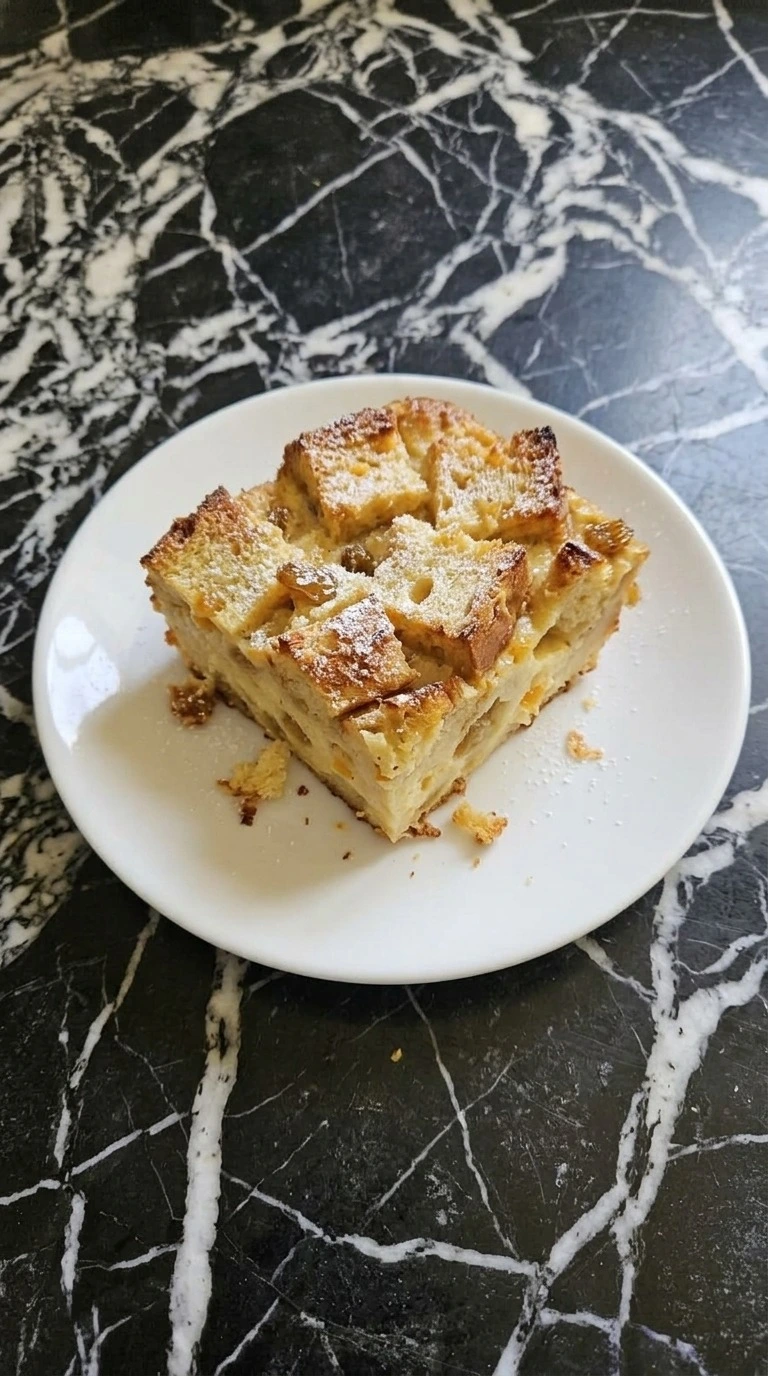
Remove the baked pudding from the oven and let it stand for 15 minutes. Then use a sharp knife to cut it into 6 generous squares while the center is still warm. Slide a wide spatula under one serving and move it carefully onto a white dessert plate. The soft middle should hold together while some tender bread pieces stay slightly loose at the edges.
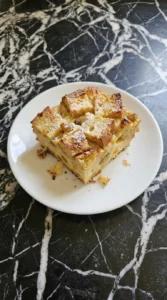
Sprinkle 2 tablespoons powdered sugar over the six servings just before serving. Aim for a light dusting rather than a solid white layer. You’ll see a creamy pale yellow inside beneath the crisp golden top. A few crumbs may fall away.
That’s fine. If you cut it straight from the oven, the soft center can collapse. Resting lets the custard settle so each portion holds its shape.
Tip: For Christmas dessert service, warm the plates briefly to around 100°F so individual portions stay pleasantly warm at the table.
Pro Tips
- Choose an 18-ounce traditional Italian fruit panettone with a light airy crumb and visible raisins. A dense loaf won’t absorb custard as evenly.
- Cut the bread into rough 1.5-inch cubes rather than tiny pieces. Larger chunks hold their shape and give the pudding a better contrast between soft centers and crisp tops.
- Use a 9-inch square baking dish with sides at least 2 inches deep. A shallow dish can spill custard as the bread expands.
- Keep the custard cold while mixing and whisk the eggs thoroughly for about 45 seconds before adding the milk. This helps prevent streaks of firm egg.
- Don’t leave the soaked bread on the counter for more than 20 minutes before baking. For longer delays, refrigerate the covered dish promptly.
- Check the center with an instant-read thermometer near the end of baking. Aim for 165°F without touching the bottom of the dish.
- For a stronger Christmas spice flavor, add an extra 1/8 teaspoon ground nutmeg to the custard. More than that can overpower the candied orange.
- Dust the finished portions with the measured 2 tablespoons powdered sugar right before serving. Adding it too early makes the sugar melt into the warm crust.
- For a chocolate orange version, fold 1/2 cup dark chocolate chips into the toasted panettone cubes before adding the custard. The chocolate melts into small rich pockets alongside the candied orange peel.
- For an apple cinnamon twist, add 1 cup finely diced Granny Smith apple between the bread cubes and increase the ground cinnamon to 1 1/2 teaspoons. The apple adds gentle tartness and extra moisture.
- For a cranberry Christmas version, scatter 1/2 cup dried sweetened cranberries between the panettone pieces before pouring over the custard. Their tart flavor balances the rich cream and sweet bread.
- For a pecan crunch version, scatter 1/2 cup roughly chopped toasted pecans over the pudding during the final 10 minutes of baking. The nuts add a crisp finish without changing the soft custard beneath.
Substitutions & Variations
- Whole milk: Use 2 cups unsweetened oat milk instead of 2 cups whole milk. Oat milk makes the custard slightly lighter with a mild grain flavor. For a fully dairy-free version, replace the heavy cream with 1 cup dairy-free whipping cream and use plant-based butter.
- Traditional Italian fruit panettone: Use 18 ounces gluten-free panettone instead of regular Italian fruit panettone. Gluten-free panettone often has a more fragile crumb and absorbs liquid faster. Reduce the soaking time from 20 minutes to 10 to 15 minutes and handle the cubes gently. For another gluten-free holiday treat, try my Gluten Free Gingerbread Cookies.
- Large eggs: Replace 6 large eggs with 6 tablespoons cornstarch whisked into the cold milk and cream. This creates an egg-free pudding with a softer and more starch-like center rather than a traditional baked egg custard. Heat the liquid mixture with the cornstarch until it thickens before pouring it over the bread. Bake at 350°F until hot and set, checking after 30 minutes. The result won’t slice as firmly as the original.
- Heavy whipping cream: Replace 1 cup heavy whipping cream with 1 cup half-and-half. Half-and-half makes the pudding less rich and slightly less creamy while keeping the vanilla flavor. Use the same quantity and baking temperature. Check the center after 35 minutes because the lower-fat custard may set a little differently.
- Granulated white sugar: Use 1/2 cup packed light brown sugar instead of 1/2 cup granulated white sugar. Light brown sugar gives the custard a gentle caramel flavor and a slightly darker color. Whisk it thoroughly with the eggs so no lumps remain. This swap works especially well with the candied orange peel and golden raisins already in the panettone.
Storage Instructions
Let leftover Panettone Bread Pudding cool briefly and transfer it to airtight containers within 2 hours of baking. Store it in the refrigerator at 40°F or below for 3 to 4 days. If you’d like to freeze some, cut the chilled pudding into individual portions and wrap each piece tightly. Place the wrapped pieces in a freezer-safe container and freeze for up to 2 months for the best texture.
Thaw overnight in the refrigerator before reheating. For the best results, place a portion in a baking dish and add 1 tablespoon whole milk around its edges. Cover loosely with foil and warm at 325°F for 15 to 20 minutes until the center reaches 165°F. You can also microwave one portion in 30-second bursts until fully hot.
Discard leftovers with mold, unusual odors or a slimy surface. Don’t taste food to check whether it’s still safe.
Panettone Bread Pudding
Ingredients
Method
- Start by setting your oven to 300°F. Cut the 18-ounce Italian fruit panettone into rough 1.5-inch cubes with a serrated knife. Keep the pieces a little uneven because the smaller bits will turn crisp while the larger ones stay soft. Spread the cubes in one loose layer on a large rimmed baking sheet. Toast for 8 to 10 minutes and turn them once halfway through. Then remove the sheet and let the bread cool for 5 minutes. Don’t let it turn dark brown. The pieces should feel slightly dry on the outside but still soft when pressed in the middle. You’ll smell the orange peel as they warm. Toasting too long will make the edges hard instead of tender. A brief dry toast helps the bread absorb custard without falling apart.
- While the bread cools, crack 6 large eggs into a large mixing bowl and whisk for 45 seconds until the yolks and whites blend. Add 1/2 cup granulated white sugar and keep whisking for another minute. Next pour in 2 cups whole milk and 1 cup heavy whipping cream. Add 2 teaspoons pure vanilla extract and 1 teaspoon ground cinnamon with 1/4 teaspoon ground nutmeg and 1/4 teaspoon fine sea salt. Whisk for 60 seconds until the sugar starts to dissolve. Keep everything near 68°F and don’t heat the mix. The custard should look pale yellow with tiny cinnamon flecks spread through the liquid. No thick streaks of egg should remain. If you stop whisking too soon, some bites may have a firm eggy texture. A smooth cold custard helps the pudding bake with an even creamy center.
- Raise the oven temperature to 350°F. Rub 1 tablespoon softened unsalted butter over the bottom and sides of a 9-inch square baking dish. Transfer the toasted panettone cubes into the dish and spread them in loose uneven layers. Pour the vanilla custard slowly over the bread and make sure you reach the corners. Then press the raised cubes gently with the back of a large spoon. Let the mixture soak for 20 minutes and press the top again after 10 minutes so the dry pieces absorb more liquid. The bread should look plump and moist with a little custard still visible between the cubes. Some golden edges will stick out above the liquid. Don’t leave the mixture soaking for hours on the counter because the bread can break down. A 20-minute soak gives the centers time to soften while the tops keep their shape.
- Place the filled baking dish on the middle oven rack at 350°F. Bake for 35 to 45 minutes until the top starts to turn a deep golden color and the custard sets around the bread. At minute 35 check the middle with a thin knife and look for moist crumbs rather than liquid custard. You can also check the center with a food thermometer and aim for 165°F. If the top gets too dark before the middle sets, cover it loosely with foil for the last 10 minutes. Don’t raise the oven heat to rush it. You’ll notice crisp amber corners and a gentle wobble in the center when you move the dish. The kitchen will smell like warm vanilla and orange peel. (I found that a hotter oven made the top too dark before the center set.) Moderate heat lets the custard firm up without drying out.
- Remove the baked pudding from the oven and let it stand for 15 minutes. Then use a sharp knife to cut it into 6 generous squares while the center is still warm. Slide a wide spatula under one serving and move it carefully onto a white dessert plate. The soft middle should hold together while some tender bread pieces stay slightly loose at the edges. Sprinkle 2 tablespoons powdered sugar over the six servings just before serving. Aim for a light dusting rather than a solid white layer. You’ll see a creamy pale yellow inside beneath the crisp golden top. A few crumbs may fall away. That’s fine. If you cut it straight from the oven, the soft center can collapse. Resting lets the custard settle so each portion holds its shape.
Notes
Frequently Asked Questions
Yes, you can assemble the bread and custard in the buttered baking dish up to 12 hours ahead. Cover the dish and keep it refrigerated at 40°F or below. The bread will absorb more liquid overnight, so expect a softer texture. Take the dish out while the oven heats and bake at 350°F. Allow an extra 5 to 10 minutes if the mixture is still cold.
A watery center usually means the custard hasn’t set or the bread absorbed more liquid than expected. Check the middle with a thermometer and make sure it reaches 165°F. If liquid custard remains, return the dish to the 350°F oven for another 5 to 10 minutes. Cover the top loosely with foil if the bread edges are already dark.
Yes, you can replace the 18 ounces of panettone with the same weight of plain brioche. Since brioche usually lacks candied fruit, add 1/3 cup golden raisins and 2 tablespoons finely chopped candied orange peel if you want a similar flavor. The finished dessert will taste more buttery and less fruity without these additions. Keep the soaking time close to 20 minutes.
Keep leftover pudding in a covered airtight container in the refrigerator for up to 3 to 4 days at 40°F or below. Refrigerate it within 2 hours of baking and avoid leaving individual servings on the table for long periods. The top will gradually lose its crisp texture, but you can restore some of that texture with a short oven reheat.
Yes, double every ingredient and use two separate 9-inch square baking dishes for 12 servings. Bake both at 350°F with enough space for air to move between the dishes. Rotate their rack positions halfway through baking if your oven heats unevenly. Start checking the centers at 40 minutes and cook until both reach 165°F. Two dishes will heat more evenly than one very deep pan.
A warm serving tastes great with a spoonful of lightly whipped cream or a small scoop of vanilla ice cream. For Christmas brunch, try serving it alongside fresh orange segments or a bowl of Christmas Fruit Salad. Let the pudding rest for 15 minutes before plating so the soft custard stays together. The fruit helps balance the richness of the cream and sweet bread.
Yes, let the baked pudding cool and refrigerate it promptly before wrapping individual portions tightly. Freeze them in airtight containers for up to 2 months for the best texture. Thaw overnight in the refrigerator and heat in a 325°F oven for about 15 to 20 minutes until the center reaches 165°F. The custard may become slightly softer after freezing, but the flavor stays good.
Final Thoughts
After making Panettone Bread Pudding for Christmas, I wished I’d tried this recipe years ago. It would’ve saved me from wondering what to do with leftover Italian panettone after the holidays. The golden top and soft vanilla center make this version special, and I think you’ll enjoy it just as much as I do.
If you enjoyed this easy panettone bread pudding, check out my Christmas Fruit Salad and Non Alcoholic Christmas Punch for more holiday ideas. And leave a comment if you try this panettone bread pudding recipe. I love hearing how your recipes turn out, especially when you’re making them for family.
It works just as well when you are after christmas panettone bread pudding.
Panettone is a traditional Italian Christmas bread known for its tall shape and airy crumb. Its name is closely tied to Milan, where it became a holiday favorite. Because the bread already contains butter, eggs and sweet fruit, it makes a rich base for baked custard desserts. And its open crumb absorbs liquid especially well.