Patty Pan Squash Frittata
Last summer we were visiting my in-laws. My mother-in-law made this frittata three mornings in a row because the kids kept asking for it. I watched her make it four times before I figured out her little secret – she browns the squash first. The eggs don’t touch the skillet until those scalloped edges turn amber. That small step changes everything. The squash tastes sweeter and the center doesn’t turn watery. Now it’s on heavy rotation in our house too.
Honestly it took me three tries to get the balance right. The first time I packed in too much squash and it drowned everything else. The second batch had too much cheese. The third finally gave me tender eggs and golden edges with real squash flavor. We usually serve it beside a cold Mango Smoothie. Breakfast feels a little more complete that way. What I like most is how relaxed this recipe feels once the skillet goes into the oven.

The eggs settle around the vegetables. The cheese makes little golden patches instead of one heavy crust. And the scalloped squash slices stay visible, which makes every wedge look homemade. It’s practical for brunch but sturdy enough for lunchboxes. A rare win on both sides.
What Makes It Work
Patty pan squash holds more water than it looks. Browning 1/4-inch slices for 8 to 10 minutes drives that hidden moisture away. Keeping the pieces in one loose layer also builds amber edges instead of steaming them.
So the eggs stay tender rather than settling into a watery center. Starting the filled skillet on medium-low heat sets a firm rim before the 375°F bake. That rim supports the vegetables while the center reaches 160°F without tough edges.
The same moisture-first thinking helps when planning sides like Potato Salad. Dry vegetables and controlled heat make both dishes hold their texture.
Ingredient List

- Yellow patty pan squash: Choose squash 2 to 3 inches wide and slice each into 4 irregular 1/4-inch rounds.
- Extra-virgin olive oil: Use it to coat the skillet and help the squash develop amber edges.
- Yellow onion: Thinly slice it into about 20 arcs so it softens within the squash cooking time.
- Garlic: Mince finely so it perfumes the spinach without leaving harsh raw pieces.
- Baby spinach: Wash and dry thoroughly before wilting to avoid adding extra water.
- Large egg: Bring to room temperature for 20 minutes before whisking.
- Whole milk: Adds enough moisture for tender curds without making the center loose.
- Sharp cheddar: Coarsely shred it so visible pockets melt and brown across the surface.
- Parmigiano-Reggiano: Finely grate it to deepen the savory flavor and create amber freckles.
- Fresh thyme: Strip the leaves from the stems and fold them into the egg mixture.
- Kosher salt: Use 1/4 teaspoon on the vegetables and the remaining 1/2 teaspoon in the eggs.
- Freshly ground black pepper: Grind it directly into the eggs for small aromatic specks.
- Fresh dill: Tear into small fronds and add after resting for a clean herbal finish.
Kitchen Equipment
- 10-inch cast-iron skillet: A seasoned 10-inch cast-iron skillet browns the squash and moves safely into the oven, while a thin skillet can scorch the base before the center reaches 160°F.
- Large clear glass mixing bowl: A 3-quart bowl gives 8 eggs enough room to whisk without spilling, while a narrow bowl traps cheese at the bottom.
- Balloon whisk: A medium balloon whisk blends the whites in under 90 seconds, while a tiny whisk adds excess foam and slows the mixing.
- Heatproof silicone spatula: A flexible heatproof spatula folds spinach around the squash and releases the set rim, while rigid metal can scrape the skillet seasoning.
- Instant-read thermometer: A fast thermometer confirms the egg center reaches 160°F, while guessing from color alone can leave the middle loose or overcook the edges.
- Chef’s knife: An 8-inch sharp chef’s knife makes consistent 1/4-inch squash rounds, while a dull blade crushes the scalloped edges and creates uneven cooking.
How to Make It
Step 1: Slice and brown the squash

Heat the 10-inch skillet over medium-high heat, about 7 on a 10-dial, for 2 minutes. Slice 6 small yellow patty pan squash into 24 uneven 1/4-inch rounds. Thinly slice 1 small yellow onion into about 20 arcs. Add the extra-virgin olive oil and 1/4 teaspoon kosher salt.
Spread everything in one loose layer. Cook for 8 to 10 minutes and turn the pieces every 2 minutes. The squash should lose its chalky center and pick up amber spots around the scalloped edges. Meanwhile, the onion turns soft and smells lightly sweet.
Stop when the skillet looks almost dry. Go past 12 minutes and the smallest slices collapse. Pull it sooner and trapped water loosens the eggs later. Browning first removes moisture and concentrates the squash flavor.
Tip: Choose squash 2 to 3 inches wide because larger ones carry tougher seeds and need 3 extra minutes of cooking.
Step 2: Wilt the spinach with garlic

Lower the heat to medium, about 5 on a 10-dial. Add 2 minced garlic cloves and 2 packed cups baby spinach to the same skillet. Fold the greens through the hot squash for 90 seconds to 2 minutes. Rotate the skillet halfway through so the back edge doesn’t cook faster.
Keep the squash pieces visible instead of burying them under the spinach. You’ll smell toasted garlic just as the spinach darkens and shrinks to about one-third of its volume. The leaves should look glossy but no green liquid should pool underneath. Cook beyond 3 minutes and the garlic tastes bitter.
Stop too soon and the spinach leaks water during baking. Brief wilting protects the egg mixture from excess moisture.
Tip: Dry the spinach after washing for at least 10 minutes because clinging water can steam the squash instead of browning it.
Step 3: Whisk the egg and cheese mixture

While the vegetables cool for 3 minutes off the heat, keep the oven at 375°F. Crack 8 large eggs into a large bowl and whisk for 45 seconds using quick side-to-side strokes. Add whole milk and the remaining 1/2 teaspoon kosher salt and black pepper. Fold in sharp cheddar and Parmigiano-Reggiano and fresh thyme for another 20 seconds.
Scrape the bowl once so no dense egg streaks remain. The mixture should look pale gold and lightly foamy with cheese suspended throughout. Stop whisking when the whites disappear but before the foam becomes thick. Overwhisking for more than 90 seconds traps too much air and causes a puffy top that sinks.
Underwhisking leaves rubbery white patches. Short mixing builds an even curd without making the frittata spongy.
Tip: Set the eggs out for 20 minutes before whisking because room-temperature eggs blend faster and bake about 2 minutes more evenly.
Step 4: Pour the eggs over the vegetables
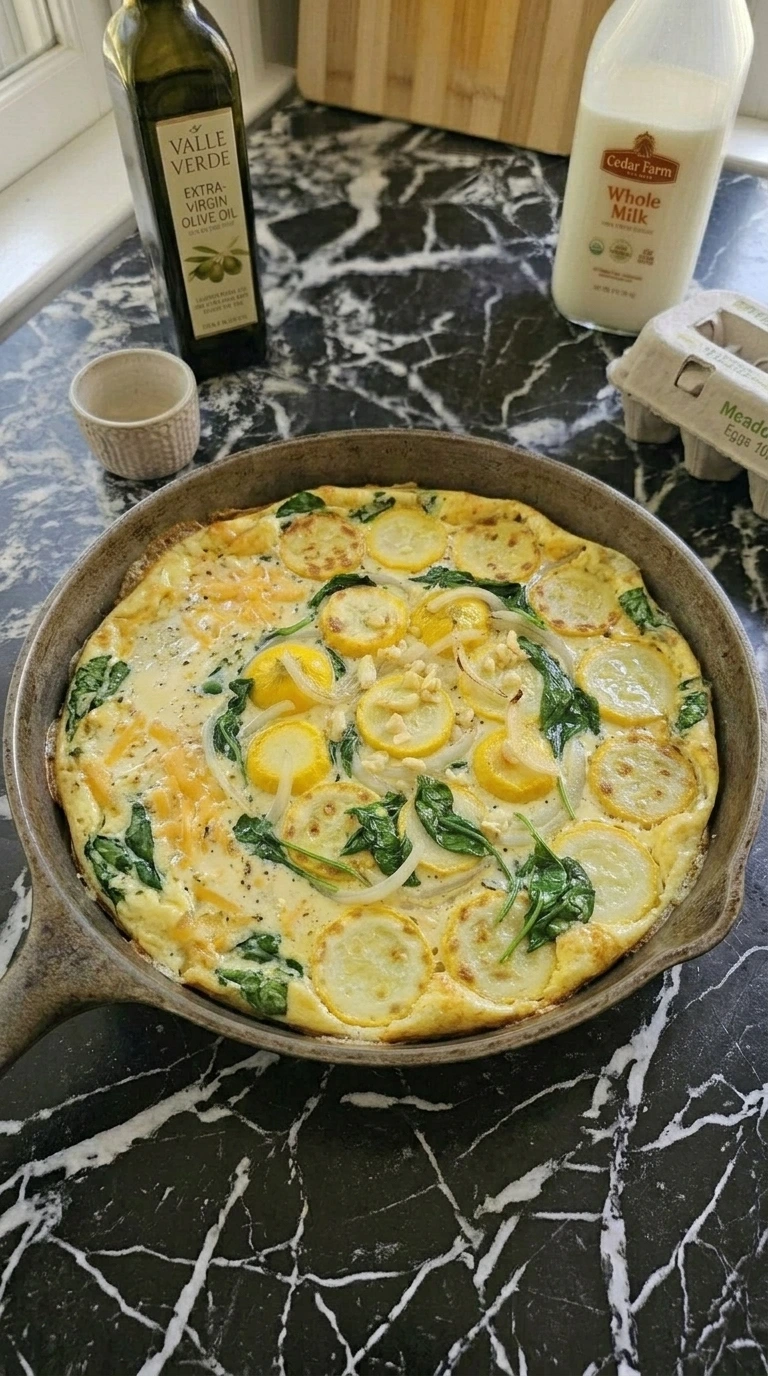
Return the skillet to medium-low heat, about 4 on a 10-dial. Redistribute the squash and spinach so bare spaces remain between pieces. Pour the egg mixture slowly from center to edge and tilt the skillet twice. Cook without stirring for 4 to 5 minutes.
Run a spatula around the rim once at minute 3 so the setting edge doesn’t stick. The rim should turn opaque while the center stays loose and glossy. Small bubbles may appear near the cheese but the surface shouldn’t boil. (I used to rush this step – the center slid under the vegetables when sliced.
) Cook longer than 6 minutes and the bottom toughens before baking. A partly set rim anchors the vegetables and supports clean slices.
Tip: Keep at least 8 squash rounds visible on top after pouring because buried pieces make the finished surface look flat and heavy.
Step 5: Bake until the center sets

Transfer the skillet to the 375°F oven and bake for 12 to 16 minutes. Check at minute 12 by nudging the center. It should wobble once as a single soft mass. Continue until an instant-read thermometer reaches 160°F at the center.
Rotate the skillet 180 degrees at minute 8 if your oven browns unevenly. Don’t wait for the middle to become rigid. The edges should puff slightly and show deep golden freckles from the cheddar and Parmigiano-Reggiano. The middle stays moist but no wet egg should shimmer when tilted.
Pull it after 165°F and the curds tighten and squeeze out moisture. Remove it below 160°F and the center may remain unsafe. Moderate oven heat sets the center before the edges turn rubbery.
Tip: Place the skillet on the upper-middle rack because a low rack darkens the bottom before the cheese develops amber freckles.
Step 6: Rest and serve a warm wedge

Rest the skillet off the heat until the center drops to about 145°F, usually 5 minutes. Sprinkle 1 tablespoon fresh dill across the top and cut the frittata into 4 uneven wedges. Slide one wedge onto a white plate with the browned top facing upward.
Let the slice stand for 2 minutes before serving so steam can escape without soaking the base. The wedge should hold clean edges while the center stays tender and speckled with squash and spinach. A few cheese strands may stretch near the cut and the top should look patchy rather than uniform.
Slice immediately and the center tears. Wait longer than 15 minutes and the surface loses its gentle warmth. Resting lets the egg proteins settle without squeezing out moisture.
Tip: Wipe the knife after each of the 4 cuts because warm cheese smears the next edge and hides the vegetable layers.
Recipe Notes
- Choose 2 to 3-inch patty pan squash because small squash has tender skin and fewer developed seeds.
- Keep every squash slice close to 1/4 inch thick so all 24 rounds soften within the same 8 to 10-minute window.
- Let the skillet heat for 2 full minutes before adding vegetables because a lukewarm pan makes the squash release water.
- Whisk the 8 eggs for no more than 90 seconds because thick foam creates a high top that collapses after baking.
- Rotate the skillet 180 degrees at minute 8 if one side of your oven colors faster than the other.
- Pull the frittata at 160°F because carryover heat raises the center a few degrees during the 5-minute rest.
- Add the fresh dill after resting so its bright aroma stays clear instead of fading during the 375°F bake.
- Add 6 ounces sliced cremini mushrooms and cook them for 6 minutes before the squash for a deeper savory version.
- Replace the thyme with 2 tablespoons chopped fresh basil and add 1 cup halved cherry tomatoes after the spinach for a brighter summer version.
- Swap sharp cheddar for 3/4 cup crumbled goat cheese and reduce the kosher salt by 1/4 teaspoon for a tangier finish.
- Fold in 4 ounces crisp chopped bacon before pouring the eggs and reduce the sharp cheddar to 3/4 cup for a smoky brunch version.
Variations to Try
- Whole milk: Use unsweetened oat milk in a 1:1 ratio. — The center stays slightly softer and the dairy flavor becomes lighter. Add 2 minutes to the oven time and still check for 160°F.
- Sharp cheddar and Parmigiano-Reggiano: Use 1 cup dairy-free cheddar shreds and 2 tablespoons nutritional yeast. — The top browns less and the texture feels a little oilier. Broil for only 30 seconds if you want extra color.
- Large eggs: Use 1 cup chickpea flour with 1 cup water and 2 tablespoons extra-virgin olive oil. — This creates a denser egg-free bake and it won’t taste exactly like frittata. Bake 8 to 10 minutes longer until the center feels firm.
- Yellow patty pan squash: Use 12 ounces small zucchini cut into 1/4-inch half-moons. — Zucchini releases more water, so sauté it for 2 to 3 extra minutes. For a sweeter brunch plate, serve it with Blueberry Muffins.
- Baby spinach: Use 2 cups thinly sliced Swiss chard. — Chard has a firmer bite and needs about 2 extra minutes in the skillet. Remove thick stems unless you like extra chew.
- Gluten-containing binders: No swap is needed because the recipe uses no flour or breadcrumbs. — Check packaged cheese and spice labels for cross-contact if sensitivity is strict. The texture stays unchanged because eggs provide the structure.
Storage Instructions
Cool leftover frittata safely within 1 hour and place the wedges in a shallow airtight container. Refrigerate them for up to 4 days. For freezing, wrap each cold wedge tightly in parchment and then foil. Store the wrapped pieces in a freezer bag for up to 2 months.
Don’t freeze the whole frittata because repeated thawing damages the tender center. Reheat refrigerated wedges at 325°F for 10 to 12 minutes and cover them for the first 8 minutes. Frozen wedges should thaw overnight before reheating for 12 to 15 minutes. Add fresh dill after warming because the original garnish loses aroma.
Discard slices with a sour smell and sticky surface or visible gray liquid. Those signs mean the eggs have spoiled.
Patty Pan Squash Frittata
Ingredients
- 6 small, about 12 ounces Yellow patty pan squash Choose squash 2 to 3 inches wide and slice each into 4 irregular 1/4-inch rounds.
- 1 tablespoon Extra-virgin olive oil Use it to coat the skillet and help the squash develop amber edges.
- 1 small Yellow onion Thinly slice it into about 20 arcs so it softens within the squash cooking time.
- 2 cloves Garlic Mince finely so it perfumes the spinach without leaving harsh raw pieces.
- 2 packed cups Baby spinach Wash and dry thoroughly before wilting to avoid adding extra water.
- 8 large Large egg Bring to room temperature for 20 minutes before whisking.
- 1/3 cup Whole milk Adds enough moisture for tender curds without making the center loose.
- 1 cup Sharp cheddar Coarsely shred it so visible pockets melt and brown across the surface.
- 1/4 cup Parmigiano-Reggiano Finely grate it to deepen the savory flavor and create amber freckles.
- 1 teaspoon Fresh thyme Strip the leaves from the stems and fold them into the egg mixture.
- 3/4 teaspoon Kosher salt Use 1/4 teaspoon on the vegetables and the remaining 1/2 teaspoon in the eggs.
- 1/4 teaspoon Freshly ground black pepper Grind it directly into the eggs for small aromatic specks.
- 1 tablespoon Fresh dill Tear into small fronds and add after resting for a clean herbal finish.
Instructions
- Heat the 10-inch skillet over medium-high heat, about 7 on a 10-dial, for 2 minutes. Slice 6 small yellow patty pan squash into 24 uneven 1/4-inch rounds. Thinly slice 1 small yellow onion into about 20 arcs. Add the extra-virgin olive oil and 1/4 teaspoon kosher salt. Spread everything in one loose layer. Cook for 8 to 10 minutes and turn the pieces every 2 minutes. The squash should lose its chalky center and pick up amber spots around the scalloped edges. Meanwhile, the onion turns soft and smells lightly sweet. Stop when the skillet looks almost dry. Go past 12 minutes and the smallest slices collapse. Pull it sooner and trapped water loosens the eggs later. Browning first removes moisture and concentrates the squash flavor.

- Lower the heat to medium, about 5 on a 10-dial. Add 2 minced garlic cloves and 2 packed cups baby spinach to the same skillet. Fold the greens through the hot squash for 90 seconds to 2 minutes. Rotate the skillet halfway through so the back edge doesn’t cook faster. Keep the squash pieces visible instead of burying them under the spinach. You’ll smell toasted garlic just as the spinach darkens and shrinks to about one-third of its volume. The leaves should look glossy but no green liquid should pool underneath. Cook beyond 3 minutes and the garlic tastes bitter. Stop too soon and the spinach leaks water during baking. Brief wilting protects the egg mixture from excess moisture.
- While the vegetables cool for 3 minutes off the heat, keep the oven at 375°F. Crack 8 large eggs into a large bowl and whisk for 45 seconds using quick side-to-side strokes. Add whole milk and the remaining 1/2 teaspoon kosher salt and black pepper. Fold in sharp cheddar and Parmigiano-Reggiano and fresh thyme for another 20 seconds. Scrape the bowl once so no dense egg streaks remain. The mixture should look pale gold and lightly foamy with cheese suspended throughout. Stop whisking when the whites disappear but before the foam becomes thick. Overwhisking for more than 90 seconds traps too much air and causes a puffy top that sinks. Underwhisking leaves rubbery white patches. Short mixing builds an even curd without making the frittata spongy.

- Return the skillet to medium-low heat, about 4 on a 10-dial. Redistribute the squash and spinach so bare spaces remain between pieces. Pour the egg mixture slowly from center to edge and tilt the skillet twice. Cook without stirring for 4 to 5 minutes. Run a spatula around the rim once at minute 3 so the setting edge doesn’t stick. The rim should turn opaque while the center stays loose and glossy. Small bubbles may appear near the cheese but the surface shouldn’t boil. (I used to rush this step – the center slid under the vegetables when sliced.) Cook longer than 6 minutes and the bottom toughens before baking. A partly set rim anchors the vegetables and supports clean slices.

- Transfer the skillet to the 375°F oven and bake for 12 to 16 minutes. Check at minute 12 by nudging the center. It should wobble once as a single soft mass. Continue until an instant-read thermometer reaches 160°F at the center. Rotate the skillet 180 degrees at minute 8 if your oven browns unevenly. Don’t wait for the middle to become rigid. The edges should puff slightly and show deep golden freckles from the cheddar and Parmigiano-Reggiano. The middle stays moist but no wet egg should shimmer when tilted. Pull it after 165°F and the curds tighten and squeeze out moisture. Remove it below 160°F and the center may remain unsafe. Moderate oven heat sets the center before the edges turn rubbery.

- Rest the skillet off the heat until the center drops to about 145°F, usually 5 minutes. Sprinkle 1 tablespoon fresh dill across the top and cut the frittata into 4 uneven wedges. Slide one wedge onto a white plate with the browned top facing upward. Let the slice stand for 2 minutes before serving so steam can escape without soaking the base. The wedge should hold clean edges while the center stays tender and speckled with squash and spinach. A few cheese strands may stretch near the cut and the top should look patchy rather than uniform. Slice immediately and the center tears. Wait longer than 15 minutes and the surface loses its gentle warmth. Resting lets the egg proteins settle without squeezing out moisture.

Notes
Nutrition
Common Questions
Yes. Brown the squash and onion and then wilt the spinach up to 24 hours ahead. Cool everything within 30 minutes and refrigerate it in a shallow sealed container. Rewarm the vegetables over medium heat for 2 minutes before adding the eggs so the skillet isn’t cold.
The squash or spinach probably kept too much moisture. Cook the squash until the skillet looks almost dry after 8 to 10 minutes. Then wilt the spinach until no green liquid pools underneath. A center below 160°F can also seem loose, so verify the temperature.
Double every ingredient and use a 12-inch oven-safe skillet or a 9 by 13-inch baking dish. The larger batch usually needs 20 to 24 minutes at 375°F. Start checking at minute 18 and remove it when the center reaches 160°F.
Use unsweetened oat milk for the whole milk and replace both cheeses with 1 cup dairy-free cheddar plus 2 tablespoons nutritional yeast. Expect less surface browning and a softer center. Bake 2 extra minutes and check that the middle reaches 160°F.
Place one chilled wedge in a small covered baking dish and warm it at 325°F for 10 to 12 minutes. Uncover for the final 2 minutes so the top loses surface moisture. The center should reach about 145°F without turning rubbery.
Yes, but freeze individual wedges rather than the whole skillet. Chill them fully first and wrap each slice twice before freezing for up to 2 months. Thaw overnight in the refrigerator and reheat at 325°F for 12 to 15 minutes.
Let Me Know
Every time I make this I remember my first attempt – nervous about watery squash and sure I needed more experience. Turns out it’s one of those dishes that forgives beginners because browned vegetables and gentle oven heat do most of the work.
You can miss the timing like I did three times and it still turns out good. If you try it, leave a comment below and then see our Pumpkin Muffins.
Patty pan squash is a summer squash, and the small scalloped fruits stay tender enough to cook with their skin intact.