Patty Pan Squash Breakfast Hash
I haven’t really shared many patty pan squash recipes on my blog, but this breakfast hash was one I had to share. The squash has a mild buttery taste and those scalloped edges catch plenty of color in a hot skillet. Add crisp potatoes and smoky bacon and soft eggs, and breakfast suddenly feels much more interesting. It’s filling without feeling heavy. Better still, every bite has a different mix of tender centers and crisp edges. This recipe takes its cue from simple farmhouse breakfasts and it’s straightforward to cook. The vegetables stay bright while the bacon adds enough richness to season the whole skillet. I like serving it with a cold Mango Smoothie when the morning is warm.
That creamy drink balances the savory hash and makes the meal feel complete without extra work. A practical brunch. And one that doesn’t leave a sink full of dishes. Some people skip patty pan squash because the shape looks awkward to cut. But the scalloped skin is tender and there’s no need to peel it. Slice each squash into uneven wedges and keep the pieces fairly thick. Then they brown outside while staying juicy in the middle. That’s the part I love most.
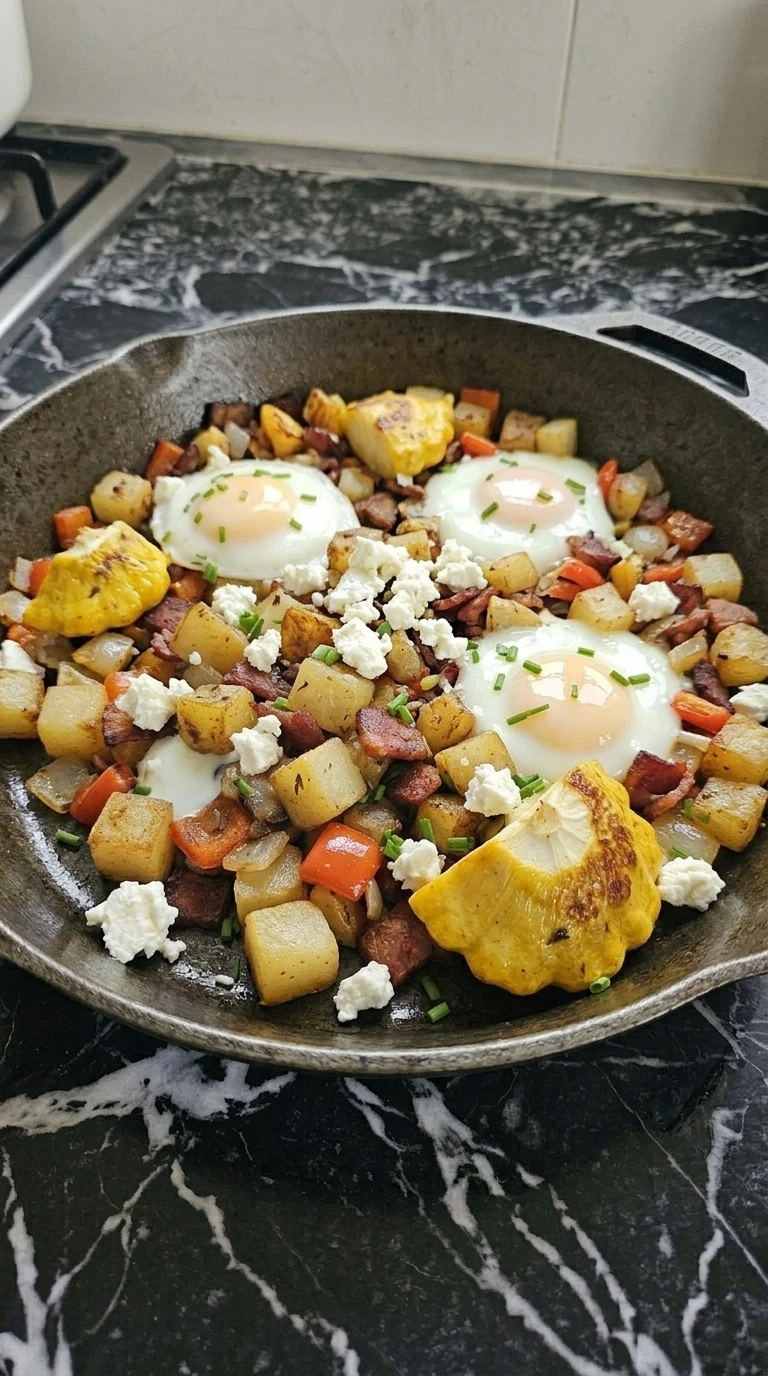
The squash doesn’t disappear into the potatoes, and it keeps its own soft texture and fresh summer flavor. This hash is quick enough for a busy morning and special enough for brunch. I recommend it when the garden is producing more squash than you know how to use. The skillet also works for a relaxed dinner because the eggs and potatoes make it satisfying. Keep the feta and chives on top. They add salty bites and fresh color, and they make the finished dish look as inviting as it tastes.
Why You’ll Love It
Drying the squash and salting it only when it reaches the skillet keeps its tender flesh from leaking water. The potatoes get a 12-minute head start at 375°F to 400°F, so their starches crisp before the squash softens. Bacon fat coats those surfaces more evenly than butter and it carries the smoked paprika through the entire hash.
A roomy 12-inch skillet matters because crowded vegetables steam instead of sear. The same spacing principle keeps the potatoes firm in our Potato Salad after boiling and cooling. Finally, baking the eggs at 375°F sets the whites gently while the yolks stay glossy and soft.
That contrast gives each serving crisp edges and a rich center.
The Ingredients

- Patty pan squash: Trimmed and cut into irregular 3/4-inch wedges, then patted very dry.
- Yukon Gold potato: Scrubbed and cut into 1/2-inch cubes for crisp edges and creamy centers.
- Applewood-smoked bacon: Cut into 1/2-inch pieces so the fat renders evenly.
- Red bell pepper: Seeded and cut into 1/2-inch dice for sweet color.
- Yellow onion: Cut into 1/2-inch dice so it softens without disappearing.
- Garlic clove: Minced finely so the flavor spreads through the skillet.
- Large egg: Cracked into individual wells for one egg per serving.
- Extra-virgin olive oil: Used to coat the potatoes and supplement the bacon fat when needed.
- Smoked paprika: Divided between the potatoes and squash for a warm smoky color.
- Fresh thyme leaves: Stripped from the stems and added with the squash.
- Kosher salt: Divided so the squash isn’t salted before it reaches the hot skillet.
- Coarsely ground black pepper: Added to the potatoes for gentle heat throughout the hash.
- Greek feta cheese: Crumbled over the hot skillet so it softens without fully melting.
- Fresh chives: Thinly sliced and scattered over the finished hash for fresh onion flavor.
Equipment
- 12-inch cast-iron skillet: A heavy 12-inch cast-iron skillet holds the vegetables in one loose layer and stores enough heat for browning, while a smaller pan traps steam and makes the squash watery.
- Large cutting board: A board at least 18 inches long keeps the squash and potatoes in separate piles, while a cramped board mixes wet squash with seasoned potatoes.
- 8-inch chef’s knife: A sharp 8-inch chef’s knife cuts the scalloped squash cleanly and keeps the pieces consistent, while a dull blade crushes the tender edges.
- Slotted spoon: A heat-safe slotted spoon lifts the bacon while leaving rendered fat behind, and a solid spoon removes too much cooking fat.
- Wide flexible spatula: A wide flexible spatula lifts each egg and the crisp potato layer together, while a narrow turner breaks the yolks and scatters the hash.
Method
Step 1: Cut and dry the vegetables

Keep the vegetables between 65°F and 70°F while you work. Cut exactly 4 medium patty pan squash into irregular 3/4-inch wedges. Cut 3 medium Yukon Gold potatoes into 1/2-inch cubes and dice the red bell pepper and yellow onion. Mince the 2 garlic cloves.
Pat every cut surface dry for 2 full minutes. Then toss only the potatoes with 1 tablespoon olive oil and half the salt and smoked paprika. The potatoes should look lightly slick while the squash stays matte and dry. You shouldn’t see water collecting under either pile.
Salt the squash now and it starts sweating before the skillet is hot. Leave the pieces damp and they’ll steam instead of turning golden. Keep the cuts uneven but close in size, so the finished hash still looks homemade. Dry surfaces brown faster because water must evaporate before the Maillard reaction starts.
Tip: Use a kitchen scale for the squash. Four medium pieces should weigh close to 1 1/2 pounds after trimming.
Step 2: Crisp the bacon and brown the potatoes

Set a 12-inch cast-iron skillet over medium heat at about 5 on a 10-dial. Add the 6 chopped bacon slices and cook for 7 to 9 minutes. Turn the pieces every 90 seconds until the fat renders. Lift out the bacon and add the seasoned potatoes. Raise the heat to medium-high at about 7 on the dial.
Spread the cubes into one layer and cook for 12 to 14 minutes. Turn them every 3 minutes. You’ll hear a steady sizzle and smell smoke before the potato edges deepen to amber. Return the bacon during the final minute and fold it through twice. The potato centers should yield to a knife but shouldn’t crumble.
Stir constantly and the crust can’t form. Go past 15 minutes and the smallest cubes scorch while larger ones stay dense. Leaving each side untouched for 3 minutes builds a crisp starch crust.
Tip: If the bacon leaves less than 1 tablespoon fat, add the remaining olive oil before the potatoes go in.
Step 3: Sear the squash with peppers and onion
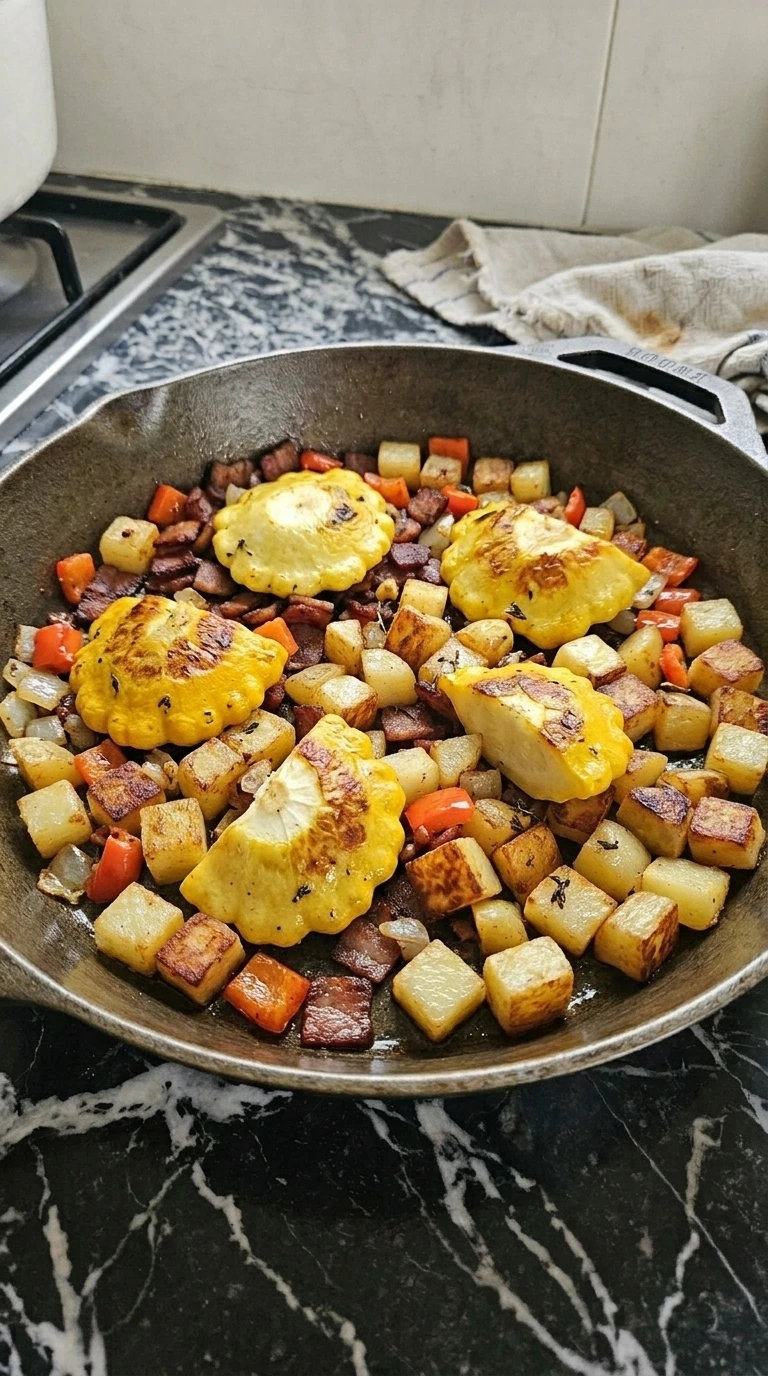
Keep the skillet at medium-high heat, about 7 on a 10-dial. Push the potatoes and bacon toward the outer edge. Add the yellow onion and red bell pepper to the center and cook for 4 minutes. Then fold in the dry patty pan squash with the garlic and thyme. Sprinkle on the remaining salt and smoked paprika.
Cook for 6 to 8 minutes and turn the pieces every 2 minutes. The squash should show deep golden patches on its cut faces while the centers stay pale and firm. The onion turns translucent and the pepper softens without collapsing. You’ll smell the garlic toast during the final minute. (My first batch stayed watery, I crowded a smaller skillet.
The 12-inch pan fixed it. ) Stir too often and the vegetables release water before they sear. High heat and open space evaporate moisture before the squash turns soft.
Tip: When using a 10-inch skillet, cook the squash in two batches for 4 minutes each before combining everything.
Step 4: Bake the eggs and finish the skillet

Heat the oven to 375°F while the vegetables finish. Use the back of a spoon to open 4 uneven wells across the hash. Crack 1 large egg into each well and keep the yolks centered. Slide the skillet into the oven for 6 to 8 minutes.
At minute 6, rotate the skillet 180 degrees. Remove it when the whites look opaque around the edges but still tremble slightly near the yolks. The yolks should stay glossy and the squash edges should hold their dark golden patches. Scatter 1/3 cup crumbled feta and 2 tablespoons sliced chives over the skillet after baking.
You’ll smell the warm thyme and bacon as the feta softens. Go past 9 minutes and the yolks firm while the squash loses its bite. Bake at 375°F because moderate heat sets the whites without toughening the yolks.
Tip: For firmer yolks, extend baking by 2 minutes and check that each yolk reaches your preferred texture.
Step 5: Plate one hearty portion

Rest the skillet off the heat for exactly 2 minutes. The serving temperature should settle near 145°F while the whites finish setting. Cut the hash into 4 loose sections without slicing through the yolks. Slide one section onto each white plate and keep one egg on every portion.
Scoop from the skillet edge toward the center, so the crisp potato crust stays attached. Finish each plate with any feta and chives left in the skillet. The plated hash should show uneven golden squash and amber potatoes with darker bacon tucked between them. The egg white should look set while the yolk remains soft and shiny.
Serve within 5 minutes because the residual heat keeps cooking the eggs. Rush the transfer and the eggs tear while the vegetables scatter. A 2-minute rest firms the whites enough for clean serving.
Tip: Warm 4 plates at 200°F for 5 minutes, so the hash stays hot while everyone sits down.
Chef’s Notes
- Choose patty pan squash under 4 inches wide because larger squash has tougher seeds and needs 2 extra minutes to soften.
- Dry the cut squash for 2 full minutes with clean towels. Any visible moisture turns the skillet steamier and weakens browning.
- Use a 12-inch cast-iron skillet. A 10-inch pan crowds 1 1/2 pounds squash and can add 5 watery minutes.
- Leave each potato side untouched for 3 minutes before turning. The crust should release cleanly when the starch has browned.
- Crack each egg into a small cup first. This prevents shell fragments and lets you fill all 4 wells within 30 seconds.
- Rotate the skillet 180 degrees at minute 6. Most ovens have a hot side that sets two whites faster.
- Finish with 1 teaspoon lemon juice when the feta tastes mild. The acid sharpens the smoky bacon without adding more salt.
- Add 1 diced poblano pepper with the red bell pepper for gentle heat and a greener roasted flavor.
- Replace the bacon with 8 ounces crumbled breakfast sausage and brown it for 8 to 10 minutes before adding potatoes.
- Fold in 2 cups baby spinach during the final 90 seconds for a softer green layer and extra vegetable volume.
- Use 1 teaspoon ground cumin instead of thyme and finish with 2 tablespoons chopped cilantro for a warmer Southwestern version.
Substitutions & Variations
- Patty pan squash: Use 1 1/2 pounds zucchini or yellow summer squash — Cut it into 1-inch half-moons and reduce the skillet time by 2 minutes. These squash varieties release more water and become softer.
- Yukon Gold potato: Use 1 pound red potato — Keep the 1/2-inch cube size and add 2 to 3 minutes. Red potatoes stay firmer and taste slightly less buttery.
- Applewood-smoked bacon: Use 6 slices certified gluten-free turkey bacon — Add 1 tablespoon extra-virgin olive oil because turkey bacon renders less fat. The hash will taste lighter and less smoky.
- Greek feta cheese: Use 1/3 cup dairy-free feta — Use the same volume and add 1 teaspoon lemon juice for sharper flavor. The sweeter contrast also works beside Pumpkin Muffins.
- Large egg: Use 1 cup drained cannellini beans — Fold them in during the final 3 minutes. The result is egg-free and less creamy, but it gains a soft earthy bite.
- Extra-virgin olive oil: Use 2 tablespoons avocado oil — Use it in the same amount. Its flavor is more neutral and its higher smoke point suits the hot skillet.
Keeping Leftovers
Cool leftover hash within 1 hour and place it in a shallow airtight container. Refrigerate it for up to 3 days. Store the eggs separately when possible because their yolks firm faster than the vegetables. You can freeze the vegetable and bacon mixture for 1 month in a flat freezer bag.
Don’t freeze the baked eggs. Their whites become rubbery and release water after thawing. Reheat the vegetable hash in a 375°F skillet for 6 to 8 minutes and turn it twice. Add 1 teaspoon olive oil if the potatoes look dry.
Reheat an egg separately at 300°F for 4 minutes or cook a fresh one. Discard leftovers if they smell sour or feel slimy. Also discard them when liquid pools heavily in the container. Fresh feta should smell clean and mildly tangy, never sharp or yeasty.
Patty Pan Squash Breakfast Hash
Ingredients
- 4 medium, about 1 1/2 pounds Patty pan squash Trimmed and cut into irregular 3/4-inch wedges, then patted very dry.
- 3 medium, about 1 pound Yukon Gold potato Scrubbed and cut into 1/2-inch cubes for crisp edges and creamy centers.
- 6 slices Applewood-smoked bacon Cut into 1/2-inch pieces so the fat renders evenly.
- 1 medium Red bell pepper Seeded and cut into 1/2-inch dice for sweet color.
- 1 small Yellow onion Cut into 1/2-inch dice so it softens without disappearing.
- 2 large Garlic clove Minced finely so the flavor spreads through the skillet.
- 4 large Large egg Cracked into individual wells for one egg per serving.
- 2 tablespoons Extra-virgin olive oil Used to coat the potatoes and supplement the bacon fat when needed.
- 1 teaspoon Smoked paprika Divided between the potatoes and squash for a warm smoky color.
- 1 teaspoon Fresh thyme leaves Stripped from the stems and added with the squash.
- 1 1/4 teaspoons Kosher salt Divided so the squash isn’t salted before it reaches the hot skillet.
- 1/2 teaspoon Coarsely ground black pepper Added to the potatoes for gentle heat throughout the hash.
- 1/3 cup Greek feta cheese Crumbled over the hot skillet so it softens without fully melting.
- 2 tablespoons Fresh chives Thinly sliced and scattered over the finished hash for fresh onion flavor.
Instructions
- Keep the vegetables between 65°F and 70°F while you work. Cut exactly 4 medium patty pan squash into irregular 3/4-inch wedges. Cut 3 medium Yukon Gold potatoes into 1/2-inch cubes and dice the red bell pepper and yellow onion. Mince the 2 garlic cloves. Pat every cut surface dry for 2 full minutes. Then toss only the potatoes with 1 tablespoon olive oil and half the salt and smoked paprika. The potatoes should look lightly slick while the squash stays matte and dry. You shouldn’t see water collecting under either pile. Salt the squash now and it starts sweating before the skillet is hot. Leave the pieces damp and they’ll steam instead of turning golden. Keep the cuts uneven but close in size, so the finished hash still looks homemade. Dry surfaces brown faster because water must evaporate before the Maillard reaction starts.

- Set a 12-inch cast-iron skillet over medium heat at about 5 on a 10-dial. Add the 6 chopped bacon slices and cook for 7 to 9 minutes. Turn the pieces every 90 seconds until the fat renders. Lift out the bacon and add the seasoned potatoes. Raise the heat to medium-high at about 7 on the dial. Spread the cubes into one layer and cook for 12 to 14 minutes. Turn them every 3 minutes. You’ll hear a steady sizzle and smell smoke before the potato edges deepen to amber. Return the bacon during the final minute and fold it through twice. The potato centers should yield to a knife but shouldn’t crumble. Stir constantly and the crust can’t form. Go past 15 minutes and the smallest cubes scorch while larger ones stay dense. Leaving each side untouched for 3 minutes builds a crisp starch crust.

- Keep the skillet at medium-high heat, about 7 on a 10-dial. Push the potatoes and bacon toward the outer edge. Add the yellow onion and red bell pepper to the center and cook for 4 minutes. Then fold in the dry patty pan squash with the garlic and thyme. Sprinkle on the remaining salt and smoked paprika. Cook for 6 to 8 minutes and turn the pieces every 2 minutes. The squash should show deep golden patches on its cut faces while the centers stay pale and firm. The onion turns translucent and the pepper softens without collapsing. You’ll smell the garlic toast during the final minute. (My first batch stayed watery, I crowded a smaller skillet. The 12-inch pan fixed it.) Stir too often and the vegetables release water before they sear. High heat and open space evaporate moisture before the squash turns soft.
- Heat the oven to 375°F while the vegetables finish. Use the back of a spoon to open 4 uneven wells across the hash. Crack 1 large egg into each well and keep the yolks centered. Slide the skillet into the oven for 6 to 8 minutes. At minute 6, rotate the skillet 180 degrees. Remove it when the whites look opaque around the edges but still tremble slightly near the yolks. The yolks should stay glossy and the squash edges should hold their dark golden patches. Scatter 1/3 cup crumbled feta and 2 tablespoons sliced chives over the skillet after baking. You’ll smell the warm thyme and bacon as the feta softens. Go past 9 minutes and the yolks firm while the squash loses its bite. Bake at 375°F because moderate heat sets the whites without toughening the yolks.

- Rest the skillet off the heat for exactly 2 minutes. The serving temperature should settle near 145°F while the whites finish setting. Cut the hash into 4 loose sections without slicing through the yolks. Slide one section onto each white plate and keep one egg on every portion. Scoop from the skillet edge toward the center, so the crisp potato crust stays attached. Finish each plate with any feta and chives left in the skillet. The plated hash should show uneven golden squash and amber potatoes with darker bacon tucked between them. The egg white should look set while the yolk remains soft and shiny. Serve within 5 minutes because the residual heat keeps cooking the eggs. Rush the transfer and the eggs tear while the vegetables scatter. A 2-minute rest firms the whites enough for clean serving.

Notes
Nutrition
FAQ
Cut the potatoes and keep them submerged in cold water for up to 12 hours, then dry them thoroughly. Cut the squash only 4 hours ahead and refrigerate it uncovered because longer storage draws moisture to the cut surfaces. Cook the bacon one day ahead and chill it separately, then rewarm it with the potatoes.
The skillet was probably crowded or the squash was salted too early, so its moisture couldn’t escape. Use a 12-inch skillet and keep the squash in a loose layer over medium-high heat for 6 to 8 minutes. Turn the pieces every 2 minutes and don’t cover the pan.
Replace the 4 eggs with 1 cup drained cannellini beans and fold them in during the final 3 minutes. The hash becomes less rich and more earthy, but it still provides a satisfying breakfast portion. Add 1 teaspoon lemon juice before serving to brighten the beans and smoky paprika.
Use two 12-inch skillets rather than one crowded pan, then divide every ingredient evenly between them. Keep the stovetop cooking times unchanged because each skillet holds the original quantity. When both skillets enter the oven, rotate them and swap racks at minute 4 so all 8 eggs set evenly.
Serve one quarter of the skillet with toast or fresh fruit for a complete brunch. A cold smoothie works well because it cools the smoky paprika and balances the salty feta. For dinner, add a simple green salad and keep each serving near 1 1/2 cups.
Freeze only the vegetable and bacon mixture after it cools completely, then pack it flat for up to 1 month. Thaw it overnight and reheat at 375°F for 8 to 10 minutes. Add freshly cooked eggs after reheating because frozen egg whites become watery and rubbery.
Before You Go
One of my signature breakfast recipes! This skillet hash uses crisp Yukon Gold potatoes, golden patty pan squash, smoky bacon and softly baked eggs.
No peeling is needed, the feta topping makes every tender bite salty and bright. Makes 4 hearty servings and pairs beautifully with Blueberry Muffins or Lemon Garlic Roast Chicken later in the day.
I still love seeing the glossy yolks settle into the crisp hash, so try it and share your skillet with me.
Patty pan squash gets its name from its scalloped flying-saucer shape. The tender skin stays edible, so peeling only wastes time and removes color.