Leftover Turkey Casserole
The fridge is still packed after Thanksgiving, and this Leftover Turkey Casserole gives that extra turkey a whole new reason to shine. Think tender pieces of roast turkey tucked into a creamy sauce with peas and carrots. Then add a layer of stuffing that turns golden in the oven. Dinner is back! Hi!
Meet your new favorite way to turn yesterday’s holiday feast into something warm and filling. This easy leftover turkey casserole has that rich gravy-like filling and those crisp little bits of stuffing on top that everyone tries to scoop up first. And the best part? You’re using food you’ve already got. If you’re planning another comforting dinner later in the week, our Fall Casserole for Dinner is worth keeping nearby.
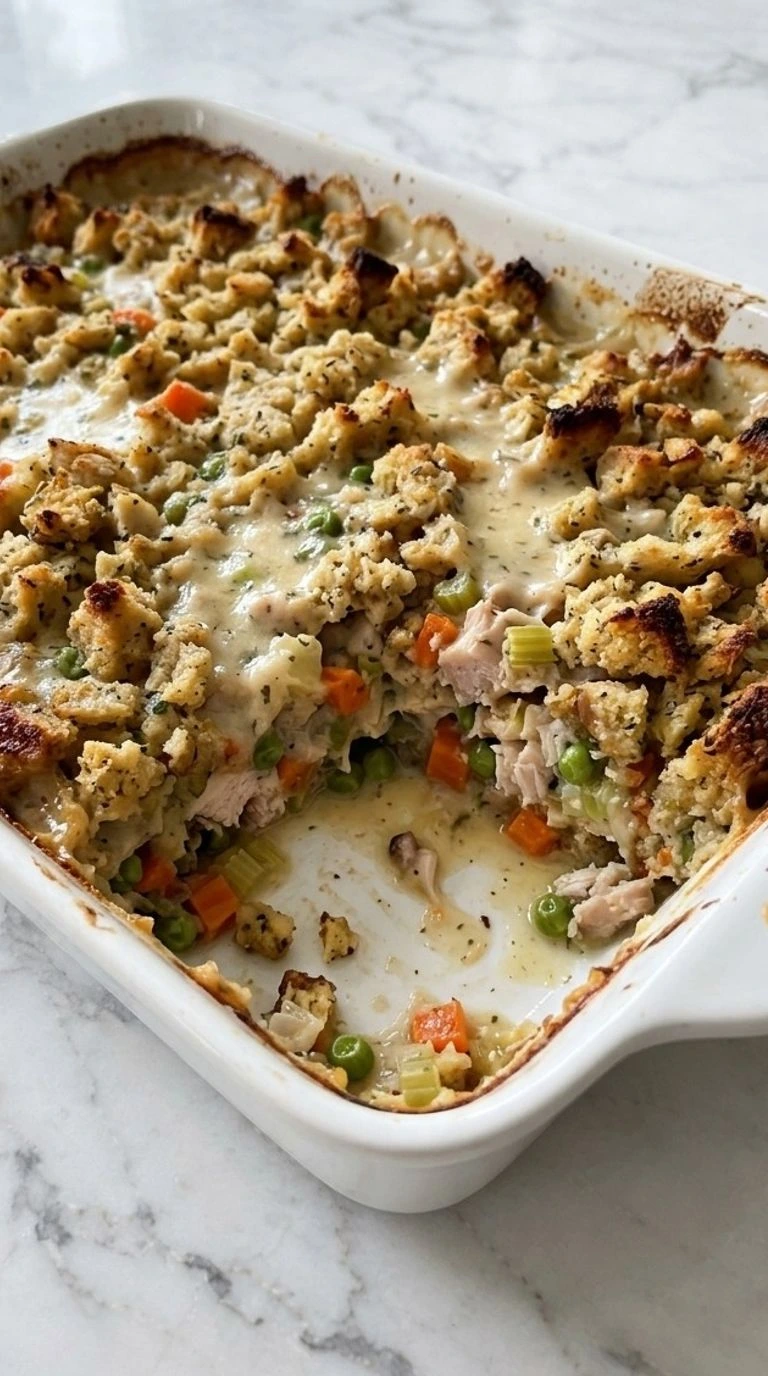
That’s right. We’re calling upon that container of leftover TURKEY to work its magic again, and it’s got plenty left to give. No dry reheated slices here. Just a creamy turkey and stuffing bake that makes the day after Thanksgiving feel like its own little celebration.
Why This Recipe Works
The best thing about Leftover Turkey Casserole is how the flour and butter hold the broth and milk together. Cooking that mixture for 3 to 5 minutes before adding the turkey gives you a thick sauce that clings to the meat instead of soaking through the stuffing.
Then a 375°F oven toasts the bread while the creamy base heats to 165°F. It’s the same hearty appeal you’ll find in our Friendsgiving Casserole by Joanna Gaines, but here the leftover stuffing becomes the crisp top.
Ingredients
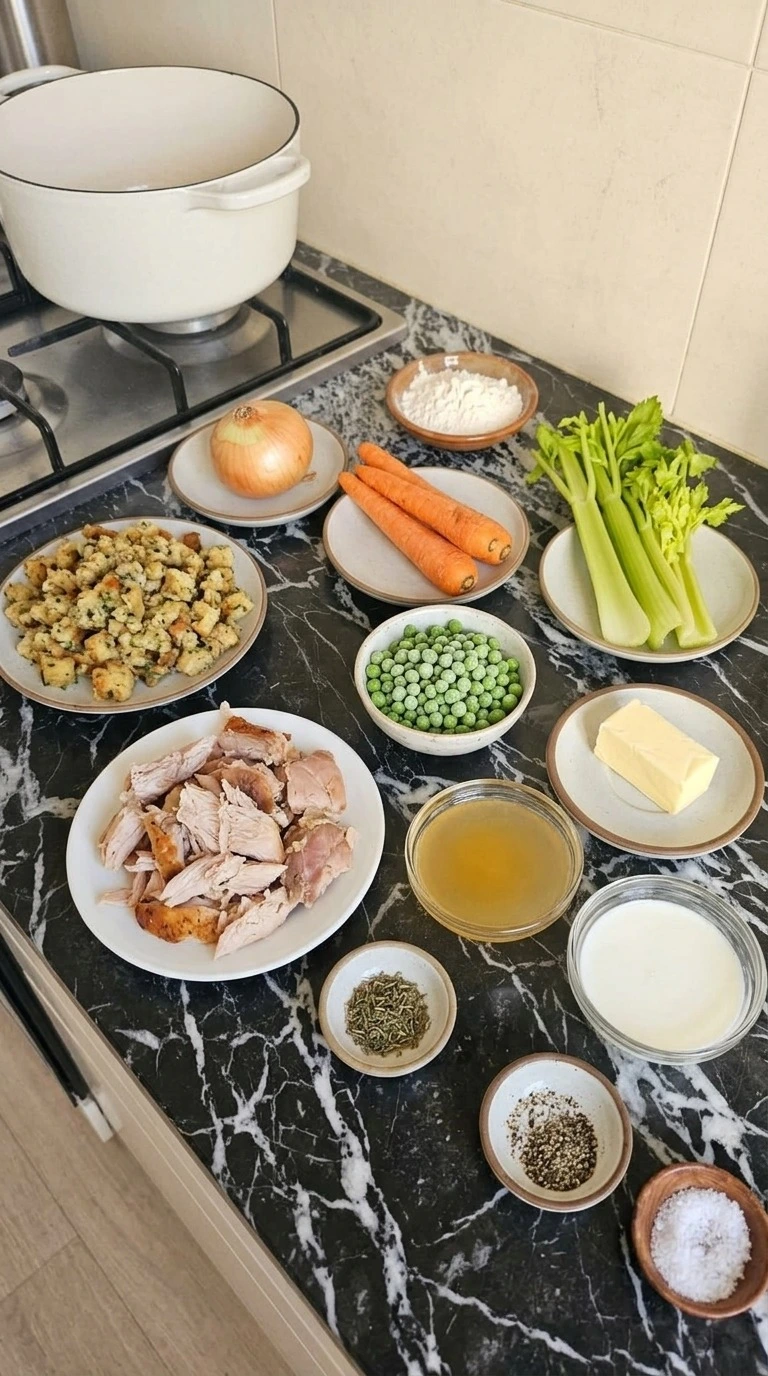
- Roasted turkey breast and thigh meat: Fully cooked and cut into 1-inch bite-size pieces. A mix of white and dark meat provides tender texture and richer flavor.
- Prepared herb bread stuffing: Previously cooked and chilled, with irregular bread pieces. Forms a lightly crisp golden crust over the creamy filling.
- Yellow onion: Peeled and finely diced. Adds sweetness and savory depth as it softens in butter.
- Carrot: Peeled and cut into 1/4-inch cubes. Adds natural sweetness and a little bite.
- Celery stalk: Trimmed and sliced into 1/4-inch pieces. Adds a mild savory flavor that pairs well with herb stuffing.
- Frozen green peas: Added straight from the freezer without thawing. Brings color and a gentle sweetness to the filling.
- Unsalted butter: Use 2 tablespoons to soften the vegetables and 2 tablespoons for the sauce. Reserve 1 teaspoon to grease the baking dish, leaving a small amount unused.
- All-purpose flour: Stirred into the melted butter before adding liquid. Thickens the turkey sauce without canned condensed soup.
- Low-sodium turkey broth: Provides a rich savory base for the sauce. Use broth made from roasted turkey bones or a prepared low-sodium version.
- Whole milk: Mixed into the broth and flour base. Softens the savory flavor and gives the sauce a smooth creamy texture.
- Dried thyme: Stirred into the sauce to add a familiar roasted poultry aroma. Rub gently between your fingers before adding.
- Kosher salt: Added to the filling after the sauce thickens. Reduce if the leftover turkey or stuffing is already heavily seasoned.
- Freshly ground black pepper: Added with the salt. Brings a mild peppery bite that balances the creamy sauce.
Kitchen Equipment
- 12-inch skillet: A heavy-bottomed 12-inch skillet gives the vegetables room to soften and the sauce space to thicken. Choose a skillet with sides at least 2 inches high because a shallow pan may overflow when you add the turkey.
- 9-by-13-inch baking dish: A 9-by-13-inch oven-safe ceramic or glass baking dish holds the creamy filling and stuffing topping in a layer that heats evenly. Avoid an 8-inch square dish because the filling will be too deep and may bubble over.
- Wooden spoon: A sturdy wooden spoon with a broad edge helps move the vegetables across the skillet without scratching the surface. Choose one long enough to keep your hand away from the hot sauce.
- Balloon whisk: A medium 10-inch balloon whisk breaks up flour lumps while you pour in the broth. A small fork can work in a pinch but may leave pockets of dry flour.
- Silicone spatula: A flexible heat-resistant silicone spatula folds the cooked turkey into the sauce without breaking the pieces apart. Look for a single-piece spatula rated to at least 400°F.
- Food thermometer: A quick-read digital food thermometer checks that the center of the casserole reaches 165°F. Choose one with a narrow probe because thick probes can give less precise readings in small portions.
- Measuring cups and spoons: Standard measuring cups and spoons keep the flour-to-liquid ratio accurate so the sauce doesn’t turn watery or pasty. Use a liquid measuring cup with at least a 2-cup capacity for the broth and milk.
- Wide serving spatula: A serving spatula with a blade around 3 inches wide lifts portions while keeping some crisp stuffing attached. A narrow spoon tends to break the topping and scatter the filling.
How to Make It
Step 1: Dice and Soften the Vegetables
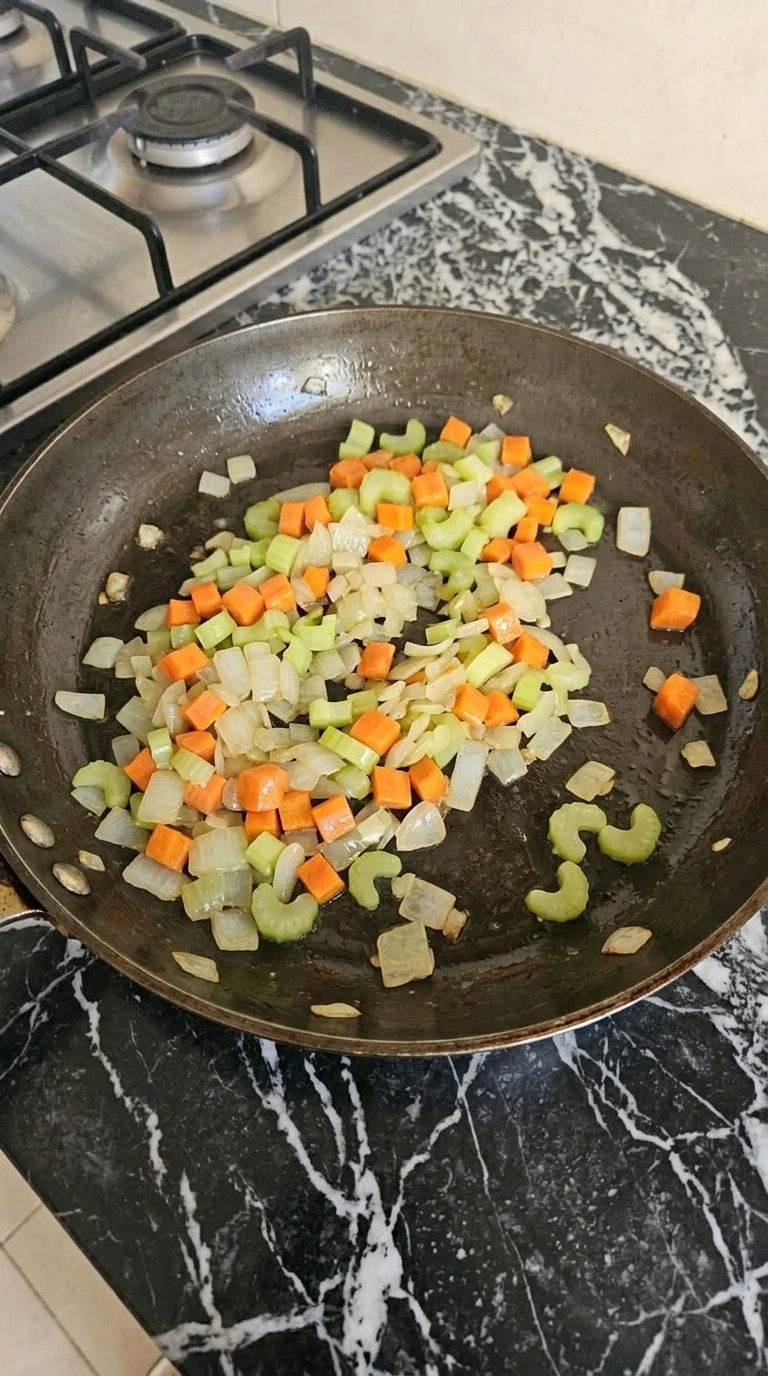
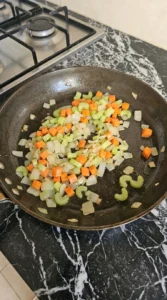
Start by peeling 2 medium carrots and cutting them into small 1/4-inch cubes. Dice 1 medium yellow onion and slice 2 celery stalks into 1/4-inch pieces. Melt 2 tablespoons of unsalted butter in a large skillet over medium heat, around 350°F at the pan surface. Add the onion, carrots and celery.
Then stir with a wooden spoon every minute for 7 to 8 minutes so the vegetables soften without taking on much color. Keep the pieces moving across the pan rather than letting them sit in one spot. The onion should turn pale and see-through while the carrots lose their hard bite. You’ll smell the sweet onion as it softens.
Stop before the vegetables turn dark brown or they’ll bring a bitter edge to the sauce. Gentle heat keeps the vegetables tender without scorching their natural sugars.
Tip: Cut the carrots slightly smaller than the celery so both soften in roughly 8 minutes. Large carrot cubes may stay firm after baking.
Step 2: Thicken the Homemade Turkey Sauce
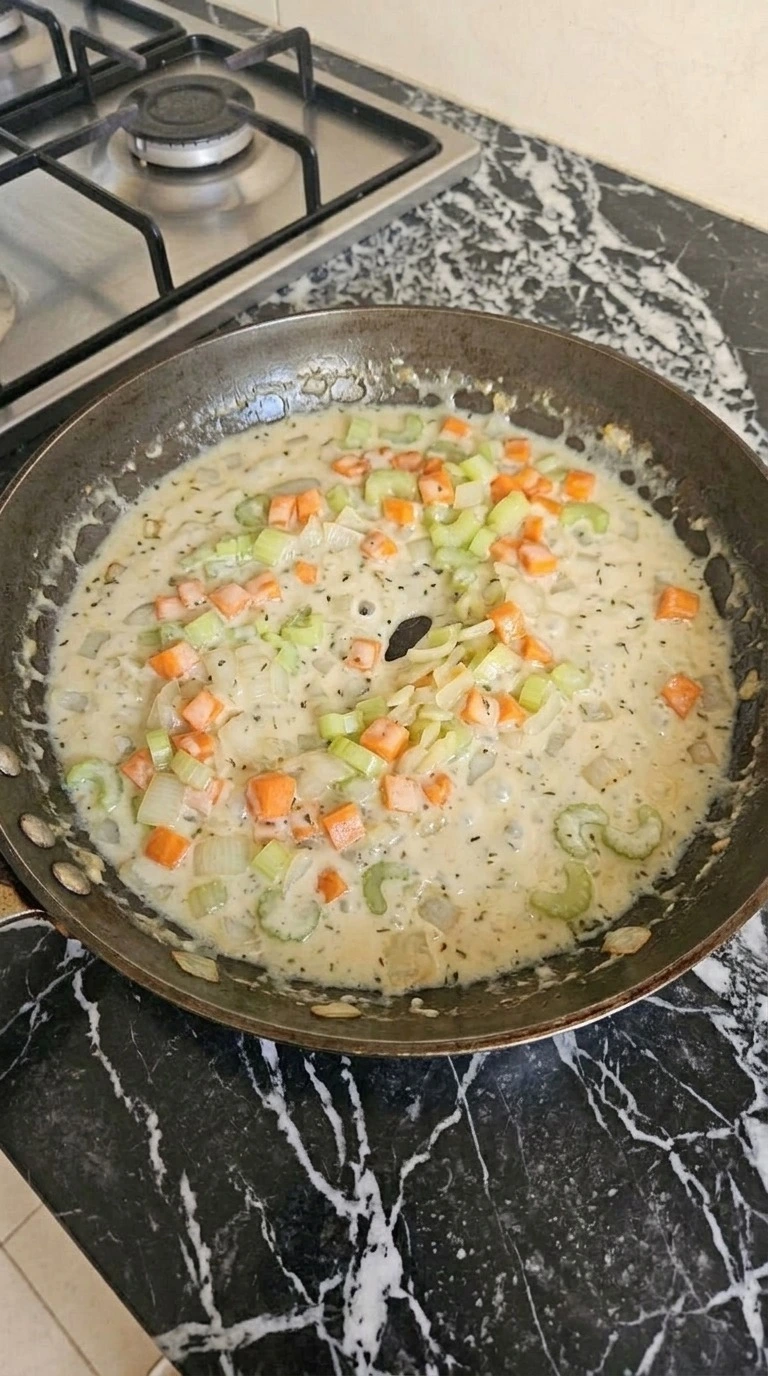
Turn the heat to medium-low, about 300°F at the pan surface. Add the remaining 2 tablespoons of unsalted butter to the softened vegetables. Once it melts, sprinkle in 1/4 cup of all-purpose flour and stir for 60 to 90 seconds. Next pour in 1 1/2 cups of low-sodium turkey broth in small splashes while whisking to break up the flour.
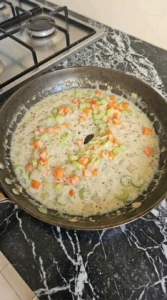
Add 1/2 cup of whole milk and 1 teaspoon of dried thyme. Keep stirring gently for 3 to 5 minutes until the mixture thickens into a smooth sauce. You’ll know it’s close when the sauce coats the back of a spoon and leaves a clear trail after you swipe through it. Thick, not pasty.
If you stop too soon, the filling can turn watery in the oven. A short simmer lets the flour absorb liquid and set the sauce.
Tip: Warm the turkey broth slightly before adding it if it’s fridge-cold. This helps the sauce regain a gentle simmer without sudden lumps.
Step 3: Fold the Turkey and Peas Into the Sauce
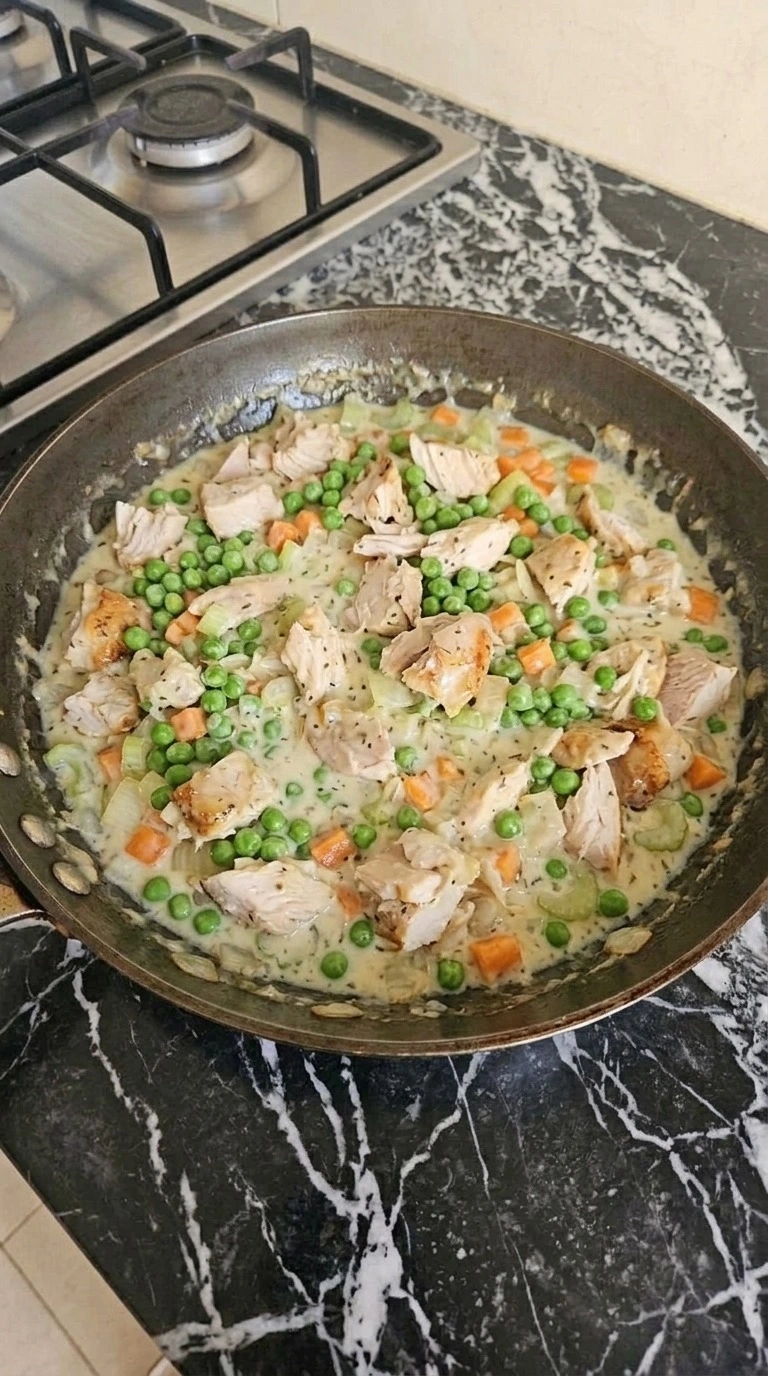
Lower the heat to low, about 250°F at the pan surface, and add 3 cups of cooked roasted turkey breast and thigh meat cut into bite-size pieces. Pour in 1 cup of frozen green peas straight from the freezer. Sprinkle in 1/2 teaspoon of kosher salt and 1/4 teaspoon of freshly ground black pepper.
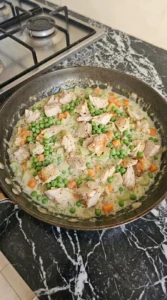
Then use a spatula to fold the mixture from the bottom toward the center for 2 to 3 minutes. Move gently so the turkey chunks keep their shape and the sauce coats everything. The turkey should look moist and fully coated while bright green peas peek through the pale filling.
You shouldn’t see dry patches. Keep this brief because a long simmer can make the already-roasted meat tough. Low heat warms the filling without drawing more moisture from the turkey.
Tip: Use a mix of roast turkey breast and thigh meat if you’ve got both. Dark meat adds richness while breast pieces keep the filling lighter.
Step 4: Spread the Filling and Add the Stuffing
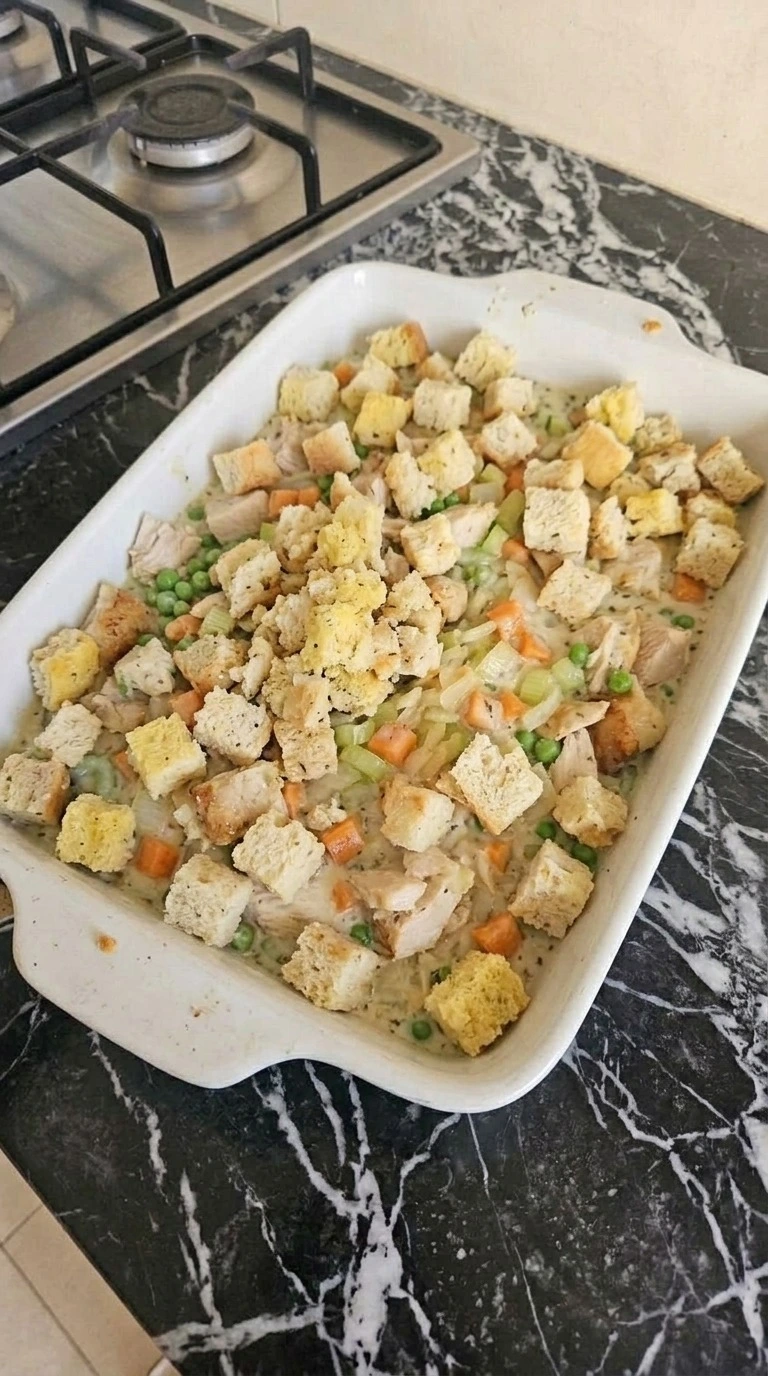
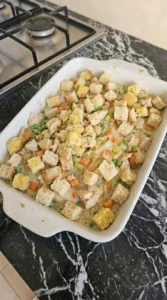
Preheat the oven to 375°F and lightly coat a 9-by-13-inch baking dish with 1 teaspoon of unsalted butter. Spoon in the turkey mixture and spread it across the bottom in an even layer. Next scatter 3 cups of prepared herb bread stuffing over the filling. Leave small gaps between the stuffing pieces so some creamy sauce stays visible.
Don’t pack the bread down. Move the larger chunks toward the middle and let the smaller pieces settle naturally near the edges. This should take about 3 to 4 minutes. The top will look uneven and slightly loose.
That’s what you want. (I prefer leaving little gaps in the stuffing because the sauce can bubble through them. ) Pressing it flat makes the topping dense and damp. Loose stuffing lets hot air dry the upper edges while the base stays moist.
Tip: If your stuffing feels dry and crumbly, sprinkle 2 tablespoons of the measured turkey broth over it before baking. Reduce the sauce broth by the same amount.
Step 5: Bake Until the Stuffing Turns Golden
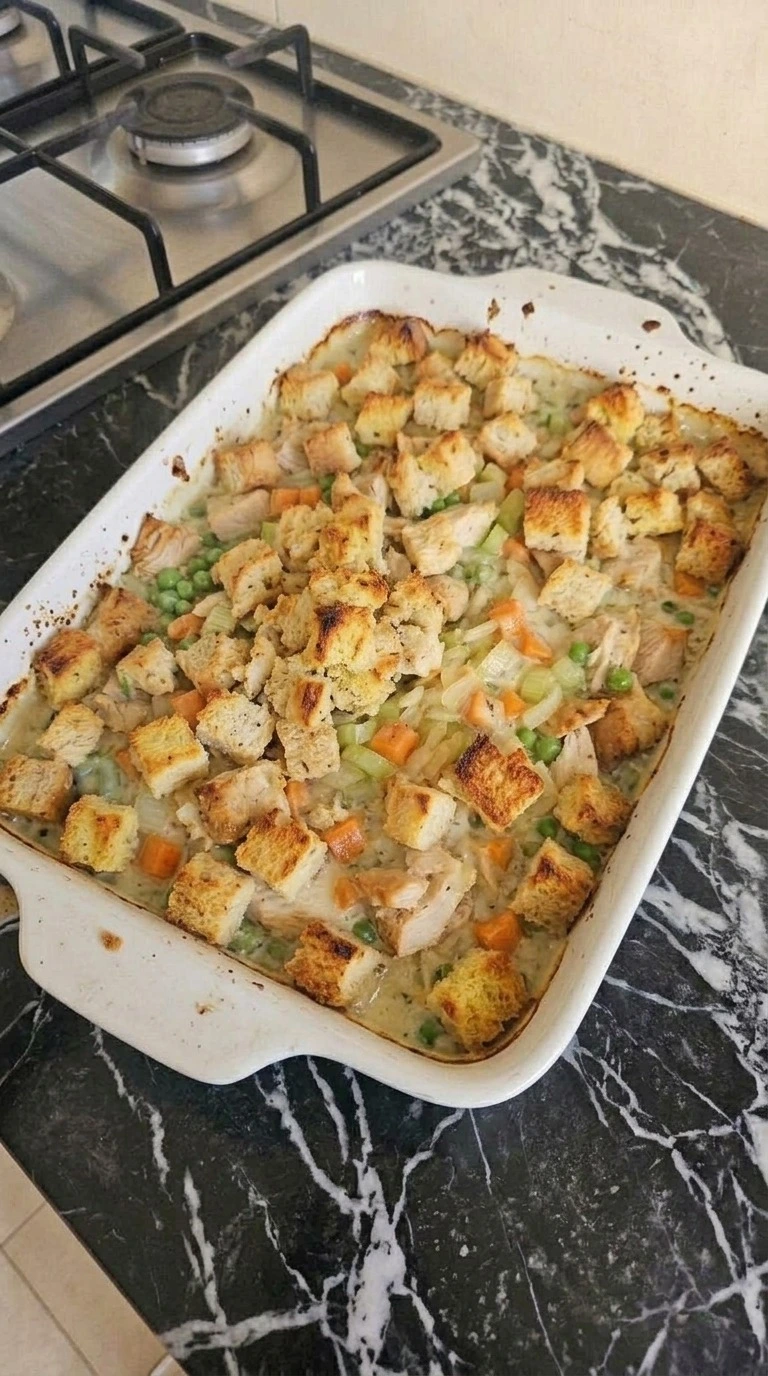
Place the assembled casserole on the center rack of a 375°F oven and bake uncovered for 25 to 30 minutes. Let the topping toast while the sauce bubbles beneath it. At minute 20, check the top through the oven window. If the stuffing starts turning too dark, cover the dish loosely with aluminum foil for the remaining time.
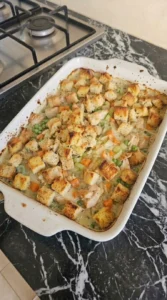
Check the middle of the filling with a food thermometer before removing the casserole. It needs to reach 165°F throughout for safe reheating. Look for deep golden spots along the stuffing edges and small bubbles near the sides of the dish. The sauce should no longer look thin.
Don’t leave it baking long after it reaches temperature or the turkey may dry out. Baking uncovered helps the stuffing crisp while the filling heats through.
Tip: If the stuffing is still pale when the center reaches 165°F, briefly broil for 1 to 2 minutes while watching closely.
Step 6: Rest and Serve a Creamy Turkey Portion
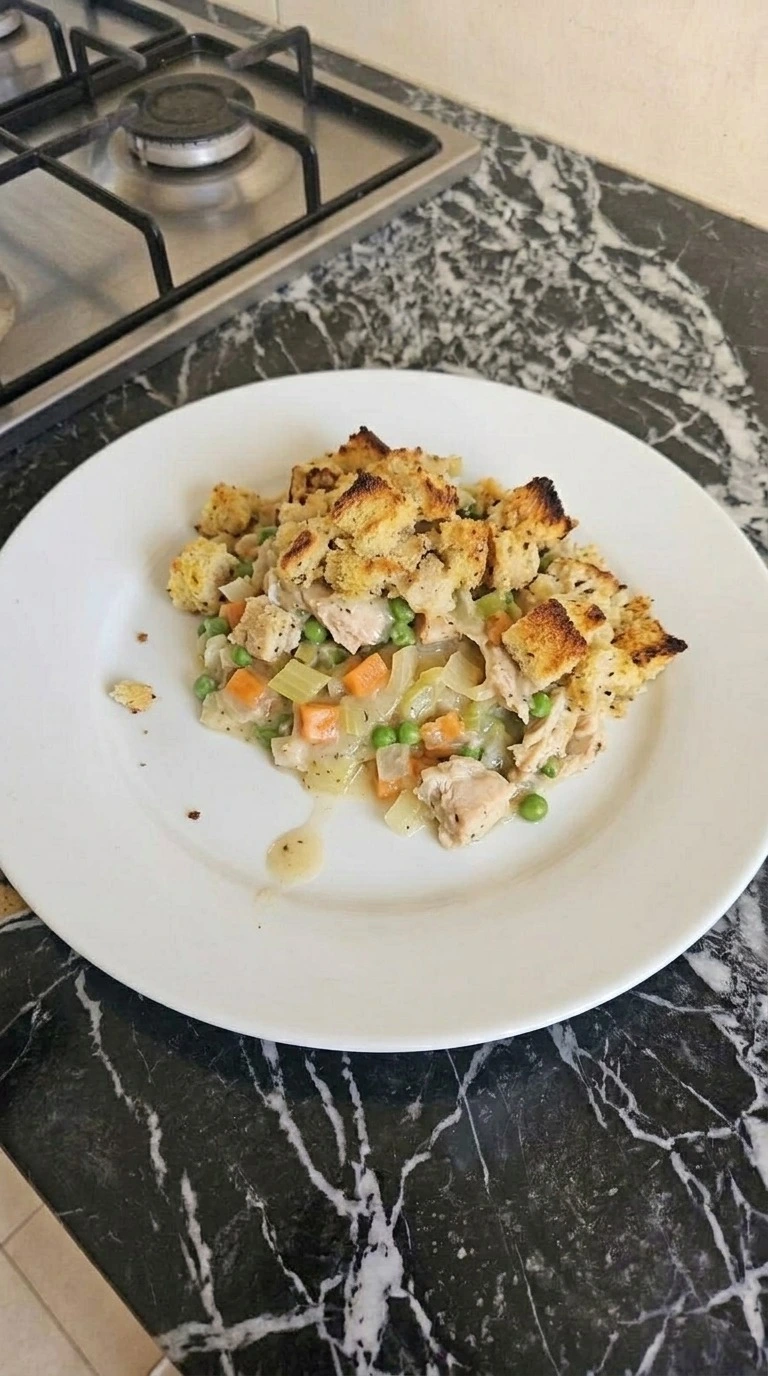
Take the casserole out of the oven and let it stand for 10 minutes before serving. The center should still be hot and the stuffing should hold its crisp top. Use a broad serving spatula to scoop one generous portion from a corner onto a white dinner plate. Slide the spatula beneath the filling rather than dragging through the bread.
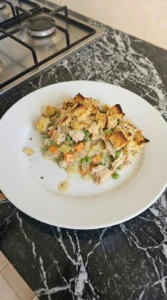
Keep some of the golden topping attached so each bite has soft turkey and crisp stuffing. A typical serving is about one-sixth of the pan. You’ll see tender turkey chunks and bright peas under the broken golden crust. A little sauce may settle along the edge of the portion.
That’s normal. Serve too soon and the hot filling can spread across the plate. A brief rest helps the thickened sauce hold the layers together.
Tip: For a holiday-style plate, serve one portion with a spoonful of cranberry sauce on the side. Its tart flavor balances the rich filling.
Pro Tips
- Cut the roasted turkey into pieces about 1 inch wide so the meat stays juicy during the 25 to 30 minutes in the oven.
- Taste your leftover stuffing before seasoning the filling because some prepared stuffing mixes already contain plenty of salt. Start with 1/4 teaspoon if yours tastes salty.
- Use a 9-by-13-inch baking dish rather than a smaller deep dish. The wider surface gives more stuffing room to develop golden edges.
- Measure the flour as a level 1/4 cup rather than packing it tightly. Too much flour can turn the sauce thick and pasty.
- If you’re using stuffing that’s been in the fridge, break apart large clumps before adding it. Pieces around 1 inch wide toast more evenly.
- Keep the casserole uncovered at 375°F unless the stuffing darkens too quickly. A tight foil cover traps moisture and softens the bread topping.
- Add 1 teaspoon of finely chopped fresh rosemary to the sauce for a stronger holiday herb flavor. Use less if your stuffing is already heavily seasoned.
- Check the center with a thermometer near minute 25 and remove the casserole once it reaches 165°F. Extra oven time can dry the turkey.
- Make a mushroom and turkey version by adding 1 cup of sliced cremini mushrooms to the onion, carrots and celery, then sautéing until their liquid evaporates.
- Give the casserole a cheesy topping by scattering 3/4 cup of freshly shredded sharp cheddar beneath the stuffing before baking. The result will be richer and slightly saltier.
- Try a cranberry holiday twist by dotting 1/3 cup of thick whole-berry cranberry sauce over the turkey filling before adding the stuffing. The tart pockets contrast with the savory sauce.
- Make a sweet potato version by replacing the herb bread stuffing with 3 cups of prepared mashed orange-fleshed sweet potatoes. Spread them in loose peaks that can brown gently at 375°F.
Substitutions & Variations
- Whole milk: Unsweetened plain oat milk. Replace the 1/2 cup of whole milk with an equal amount of unsweetened oat milk for a dairy-free sauce. The filling will taste slightly less rich and may need an extra minute to thicken. Use plant-based butter as well to make the sauce fully dairy-free.
- All-purpose flour: Cornstarch. For a gluten-free filling, replace the 1/4 cup of flour with 2 tablespoons of cornstarch mixed into 3 tablespoons of cold broth taken from the measured amount. Add the mixture after the broth and milk begin to simmer. The sauce will look slightly glossier. You’ll also need certified gluten-free bread stuffing.
- Roasted turkey breast and thigh meat: Cooked rotisserie chicken. Use 3 cups of shredded rotisserie chicken instead of turkey. The flavor will be a little milder, but the creamy filling and stuffing topping still pair well with it. If you enjoy chicken-based comfort food, try our Chicken Pot Pie Soup for another dinner idea.
- Prepared herb bread stuffing: Prepared mashed Yukon Gold potatoes. Replace the 3 cups of stuffing with 3 cups of thick mashed Yukon Gold potatoes. Spread them gently over the filling and bake at 375°F until the center reaches 165°F. The topping will be soft rather than crisp, so don’t expect the same toasted bread texture.
- Frozen green peas: Frozen cut green beans. Replace 1 cup of frozen peas with 1 cup of frozen cut green beans. Cut any long pieces into 1-inch sections before mixing them into the sauce. The beans have a firmer bite and a less sweet flavor, so the casserole will taste slightly more savory. The recipe contains no eggs, so no egg replacement is needed.
Storage Instructions
Let the casserole stop steaming heavily and divide leftovers into shallow airtight containers within 2 hours of baking. Store at 40°F or below and use within 3 to 4 days of the turkey’s original cooking date. Making a casserole doesn’t restart the leftover storage clock. For longer storage, freeze individual portions as soon as possible.
Wrap tightly or use freezer-safe containers and aim to enjoy them within 2 to 3 months for the best texture. The stuffing may soften after freezing, but the filling should remain creamy. For reheating, place a chilled portion in an oven-safe dish and add 1 to 2 tablespoons of low-sodium turkey broth. Cover loosely and heat at 350°F for about 15 to 25 minutes or until the center reaches 165°F.
Uncover briefly if you want a drier topping. Discard leftovers with mold or an unusual smell, and don’t rely on smell alone to judge safety. If the turkey sat out too long before refrigeration, throw it away rather than reheating it.
Leftover Turkey Casserole
Ingredients
Method
- Start by peeling 2 medium carrots and cutting them into small 1/4-inch cubes. Dice 1 medium yellow onion and slice 2 celery stalks into 1/4-inch pieces. Melt 2 tablespoons of unsalted butter in a large skillet over medium heat, around 350°F at the pan surface. Add the onion, carrots and celery. Then stir with a wooden spoon every minute for 7 to 8 minutes so the vegetables soften without taking on much color. Keep the pieces moving across the pan rather than letting them sit in one spot. The onion should turn pale and see-through while the carrots lose their hard bite. You’ll smell the sweet onion as it softens. Stop before the vegetables turn dark brown or they’ll bring a bitter edge to the sauce. Gentle heat keeps the vegetables tender without scorching their natural sugars.
- Turn the heat to medium-low, about 300°F at the pan surface. Add the remaining 2 tablespoons of unsalted butter to the softened vegetables. Once it melts, sprinkle in 1/4 cup of all-purpose flour and stir for 60 to 90 seconds. Next pour in 1 1/2 cups of low-sodium turkey broth in small splashes while whisking to break up the flour. Add 1/2 cup of whole milk and 1 teaspoon of dried thyme. Keep stirring gently for 3 to 5 minutes until the mixture thickens into a smooth sauce. You’ll know it’s close when the sauce coats the back of a spoon and leaves a clear trail after you swipe through it. Thick, not pasty. If you stop too soon, the filling can turn watery in the oven. A short simmer lets the flour absorb liquid and set the sauce.
- Lower the heat to low, about 250°F at the pan surface, and add 3 cups of cooked roasted turkey breast and thigh meat cut into bite-size pieces. Pour in 1 cup of frozen green peas straight from the freezer. Sprinkle in 1/2 teaspoon of kosher salt and 1/4 teaspoon of freshly ground black pepper. Then use a spatula to fold the mixture from the bottom toward the center for 2 to 3 minutes. Move gently so the turkey chunks keep their shape and the sauce coats everything. The turkey should look moist and fully coated while bright green peas peek through the pale filling. You shouldn’t see dry patches. Keep this brief because a long simmer can make the already-roasted meat tough. Low heat warms the filling without drawing more moisture from the turkey.
- Preheat the oven to 375°F and lightly coat a 9-by-13-inch baking dish with 1 teaspoon of unsalted butter. Spoon in the turkey mixture and spread it across the bottom in an even layer. Next scatter 3 cups of prepared herb bread stuffing over the filling. Leave small gaps between the stuffing pieces so some creamy sauce stays visible. Don’t pack the bread down. Move the larger chunks toward the middle and let the smaller pieces settle naturally near the edges. This should take about 3 to 4 minutes. The top will look uneven and slightly loose. That’s what you want. (I prefer leaving little gaps in the stuffing because the sauce can bubble through them.) Pressing it flat makes the topping dense and damp. Loose stuffing lets hot air dry the upper edges while the base stays moist.
- Place the assembled casserole on the center rack of a 375°F oven and bake uncovered for 25 to 30 minutes. Let the topping toast while the sauce bubbles beneath it. At minute 20, check the top through the oven window. If the stuffing starts turning too dark, cover the dish loosely with aluminum foil for the remaining time. Check the middle of the filling with a food thermometer before removing the casserole. It needs to reach 165°F throughout for safe reheating. Look for deep golden spots along the stuffing edges and small bubbles near the sides of the dish. The sauce should no longer look thin. Don’t leave it baking long after it reaches temperature or the turkey may dry out. Baking uncovered helps the stuffing crisp while the filling heats through.
- Take the casserole out of the oven and let it stand for 10 minutes before serving. The center should still be hot and the stuffing should hold its crisp top. Use a broad serving spatula to scoop one generous portion from a corner onto a white dinner plate. Slide the spatula beneath the filling rather than dragging through the bread. Keep some of the golden topping attached so each bite has soft turkey and crisp stuffing. A typical serving is about one-sixth of the pan. You’ll see tender turkey chunks and bright peas under the broken golden crust. A little sauce may settle along the edge of the portion. That’s normal. Serve too soon and the hot filling can spread across the plate. A brief rest helps the thickened sauce hold the layers together.
Notes
Frequently Asked Questions
Yes, you can make the vegetable and turkey filling up to 24 hours before baking. Spread it in the baking dish and cover it tightly before refrigerating at 40°F or below. Keep the stuffing in a separate covered container so it doesn’t absorb too much sauce. Add the topping just before baking and allow about 30 to 40 minutes at 375°F for the chilled casserole to reach 165°F.
Keep the finished casserole in a covered food-safe container at 40°F or below. Plan to eat it within 3 to 4 days of when the turkey was first cooked, not 3 to 4 additional days after making the casserole. If you’re using turkey from Thanksgiving Thursday, aim to finish or freeze the remaining portions by Monday. Refrigerate promptly and never leave the casserole at room temperature for more than 2 hours.
Yes, but you’ll need a prepared topping rather than dry bread cubes alone. Use 3 cups of cooked herb bread stuffing or 3 cups of thick mashed Yukon Gold potatoes. You can also use 3 cups of prepared wild rice stuffing for a nuttier flavor and firmer texture. Whatever you choose, keep the turkey filling underneath the topping and heat the casserole until its center reaches 165°F.
A thin filling usually means the flour and liquid mixture didn’t simmer long enough or the vegetables released extra moisture. Let the sauce bubble gently for 3 to 5 minutes before adding the turkey and look for a coating on the back of a spoon. If you’re adding mushrooms, sauté them until their liquid evaporates. Also drain any watery leftovers before mixing them into the sauce.
Absolutely. Double every ingredient and divide the mixture between two 9-by-13-inch baking dishes instead of using one extra-deep pan. Bake both at 375°F with space for air to move between them. Rotate their positions halfway through if they’re on separate oven racks. Begin checking at 30 minutes and make sure both casseroles reach 165°F in the center before serving.
Since the casserole already includes turkey, vegetables and bread stuffing, something light or tart makes a nice side. Try a crisp green salad with 2 tablespoons of lemon vinaigrette per serving or a spoonful of cranberry sauce. For a bigger holiday spread, our Sweet Potato Casserole with Pecans adds a sweeter contrast. Serve the casserole warm after its 10-minute rest.
Yes, provided the turkey has been stored safely since its original cooking day. Freeze cooled portions promptly in airtight freezer-safe containers and use within 2 to 3 months for the best texture. Thaw overnight in the refrigerator before reheating. Cover loosely and warm at 350°F until the center reaches 165°F, adding 1 to 2 tablespoons of turkey broth if the filling looks dry.
Final Thoughts
The day after a big holiday dinner feels so much easier when this Leftover Turkey Casserole is on the menu. I wish I’d started making it years ago because it would have saved so many evenings of trying to figure out what to do with all that extra turkey. And now this easy leftover turkey casserole is one of my favorite ways to turn the leftovers into a real family meal.
That creamy filling with its crisp stuffing top makes all the difference. If you enjoyed this, try our Fall Casserole for Dinner or Turkey Meatloaf next. And leave a comment if you make it.
I read every single one and it really makes my day. Come back to it whenever you need thanksgiving leftover turkey casserole and leftover turkey casserole recipe.
Turkey and stuffing have shared American Thanksgiving tables for generations, but baking them together gives the leftovers a new texture. The moist filling warms the underside of the bread while the exposed top turns crisp. Two familiar holiday dishes become one satisfying dinner.